3 ways to help the author that COST YOU ABSOLUTE ZERO ! see the bottom of the page.
A garden diary
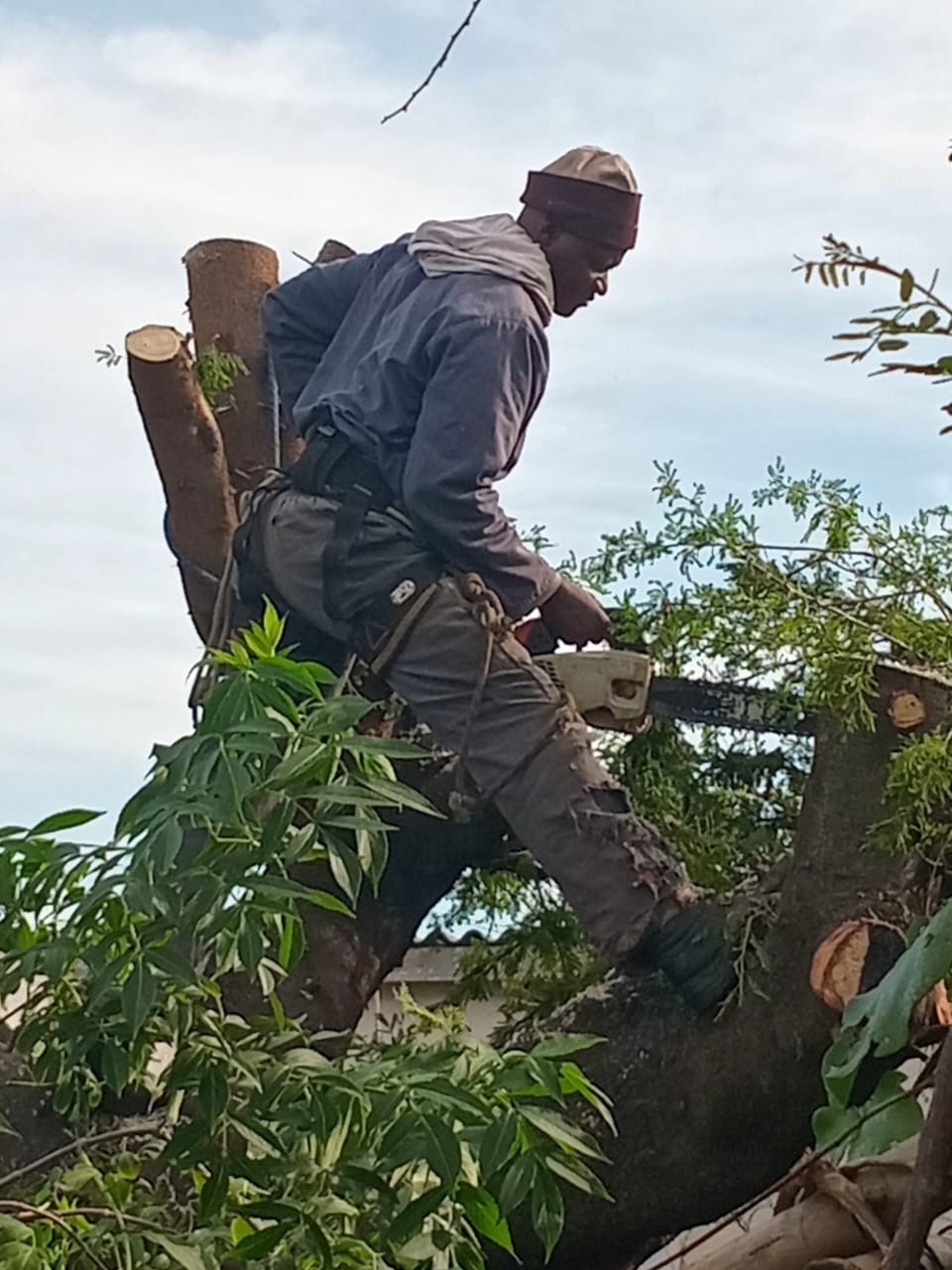 An arborist finishing off the Vichellia karoo, the great catalyst for garden changes.
I'm a 66 year old (in 2026) female gardener living in Cape Town, South Africa. I'm attempting to design a garden that caters for wildlife and biodiversity while also producing food, and learning as I go. I have a miniscule budget, amounting to about R1000 (61 USD) a year for seeds and plant purchases. However I do employ my mother's gardener once a week, so effectively the garden labour amounts to two mornings a week plus regular watering in summer.
Experiment a lot and you’ll have lots of failures. Everything I do in the garden is an experiment. I do so much and till now have never turned most of it into ‘content’ if there isn’t a neat, instagram worthy success story. But I can’t write any more about successes, neat stories, exclusively. One learns a lot from the kind of research I used to do for my articles, but one can learn even more from failures in practice.
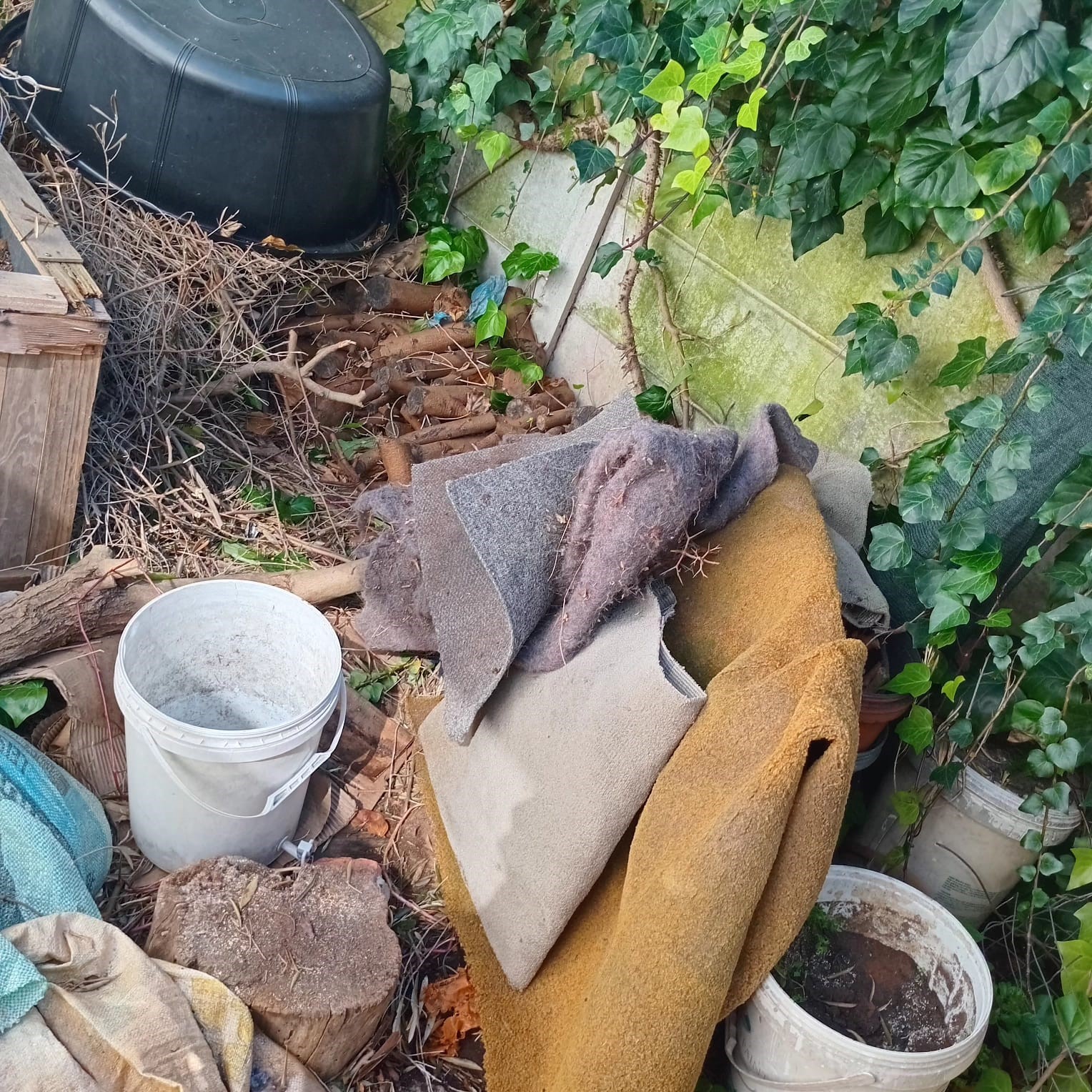 The aftermath of experiment is so often a frightful mess. Remains of carpet tubes lined with black bags and filled with soil. My beans love them but the eye does not. Slow replacement needed. Felled trees and gifts of pigeon manure add to the chaos.
I’ve decided to share my failures, the awkward stages in a project when there is more mess than beauty, the projects and plants which just fizzle out and die, the frustrating obstacles and the hard dirty work. The project of gardening is incomplete without struggle, and the solution focussed ‘how to’ article gets old with me, is so pedantic and so empty of truth and complexity and learning opportunities.
I work on the garden once a week with my mother’s gardener as I’ve so many demands in the rest of my life, caring for two disabled people till recently and trying to earn a living when gardening doesn’t make me any money. This lack of time is such a common experience and no reason to give up on the beauty of gardening. Rather it is practice in how to make the most of a few hours a week and a small small budget. It isn’t ever no cost, because however you swing it at the very least your time is always worth something, but one can do it without purchasing anything. Working with limited time and financial resources I will have experiences useful to many people. As a vehicle for sharing writing which is observation and reflection based rather than results based I thought a diary would be the best. So I start this month, in the middle of our winter in the southern hemisphere.
You could say the giant sweet thorn in our garden was the catalyst for a great turnaround in the garden project. It was all about clearing up mess as an impetus, and then, the logic of the 'nutrition zones' began to emerge. This requires a few words so I'll get back to it later.
My ten year old jungly garden was a wreck after hubby felled the lower branches of the big thorn tree, for which I’m grateful. He piled the brush (there was nowhere else for it to go) ontop of the thicket of shade plants which were under the tree, killing the wild hibiscus, haemanthus, clivias, and giant fig leafed daisy and leaving a massive brown eyesore to look at from the back door.
I was rather dispirited by the look of the garden and also overwhelmed by a freelance agroecology book illustration deadline and just gave up gardening for a while. After several months hiatus I tackled the garden again and decided on a complete redesign. The garden evolves, we evolve, everything changes. The apparent devastation of the garden became an opportunity to finally put some ideas into practice and start a biodiversity garden from scratch.
I removed and burned the big brown pile to create wood for future cooking and 60 liters of biochar...called in an arborist who took the big thorn tree down to a single short trunk. Its unfortunate but the tree will be maintained with pollarding, as it gets very out of control, loosening roof tiles, shading the whole garden and needing very expensive trimming every few years, and the long and lasting thorns require special treatment you wouldn’t need for oak branches.
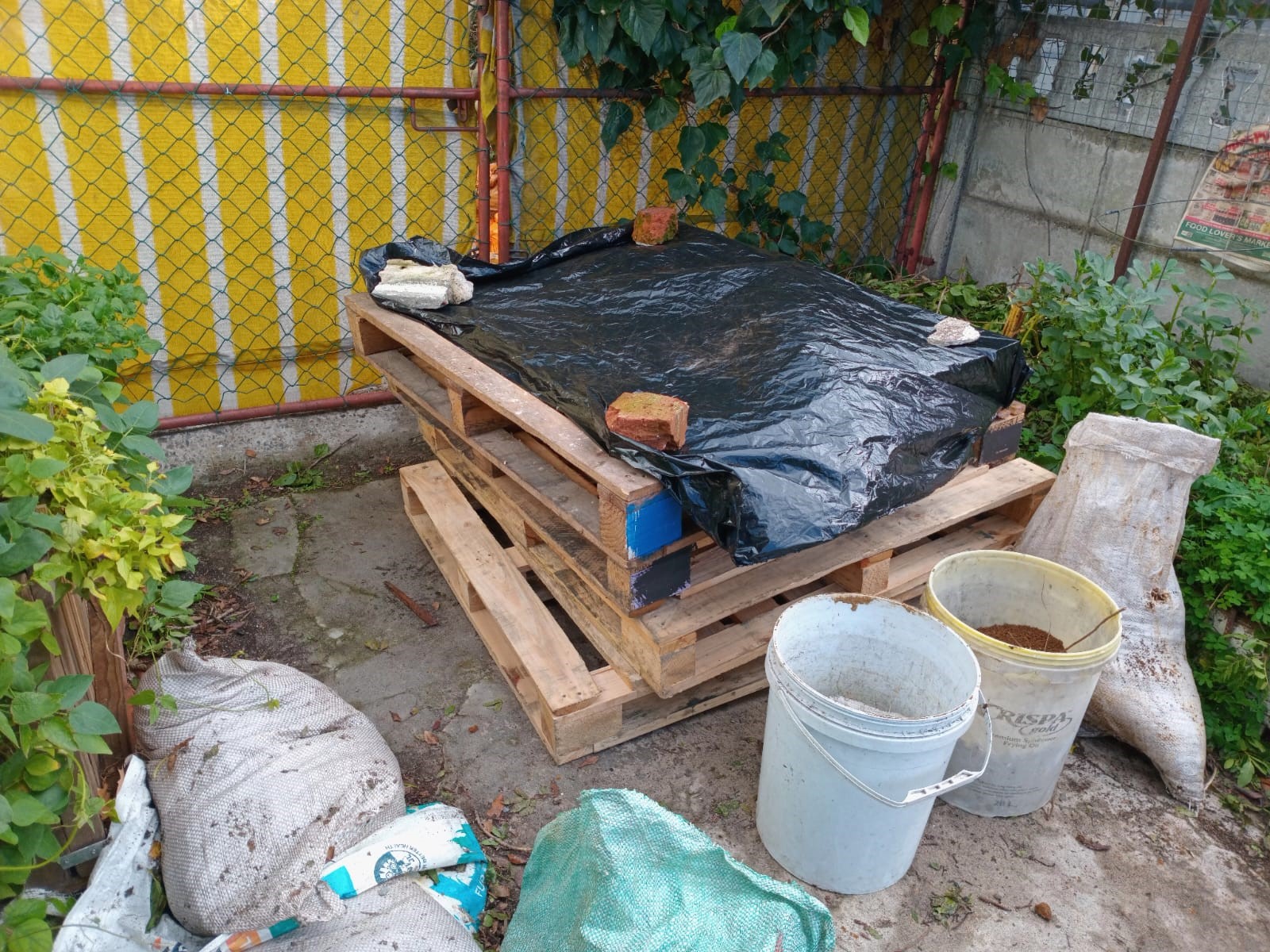 Another source of mess is building materials for future plans. Pallets waiting for assembly into raised beds, and clay to improve my sandy soil clog the driveway.
MY NEW GARDEN PLAN CONCEPT
In our new sunshiny garden space I’m adding 7 grow beds made from pallets in the under utilized or dead areas of the garden. In front of this semi circle of wooden boxes there will be new sand fynbos based, native flower beds. The flowers will be closest to the sitting area under my bamboo trellis that my impatient-patients (sister with Parkinsons and 95 year old mother) have enjoyed almost daily. Closest to the sitting area will also be a small pond for wildlife that comes to us uninvited. The three large koi ponds with three flow-bin filters are steep sided and strictly maintained for cleanliness and oxygenation by my husband, and they are not designed to be wildlife ponds. They are also ugly and I intend screening them with more pallet wood. So beyond the organic irregularly shaped flower beds will be the semicircle of wooden raised beds, and behind them will be a circle of very small fruit trees like papaya, Congolese bananas, tamarillo and some heavily pruned native berry bushes (all of these grown from seed or gifted). This grand semi circle will be enriched both in the grow beds and the tree line, along which I’ll have trenches for organics and water collection, cover crops and more. The path through the line of pallets will wend its way down the centre of the garden to the wildest part, already growing high with out of control indigenous and climate adapted plants. I will not need to plant anything there, just trim and mulch. It could serve as a source of organics for the fruit trees.
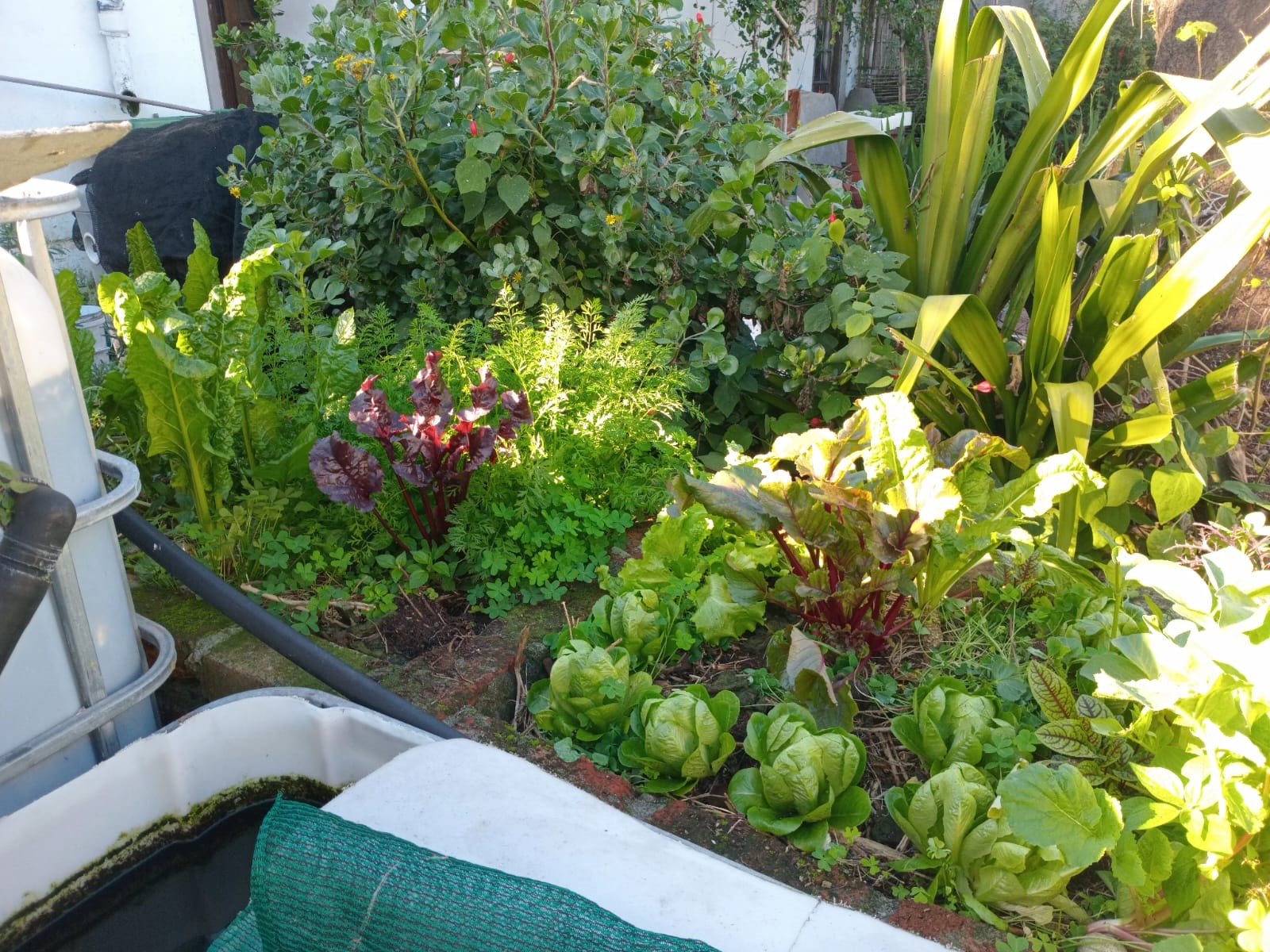 My sequential wicking bed is ten years old now, and brings in a harvest all year round without a soil change. This is what my book is about. Planted lettuce starts just after rethinking the garden.
I hope to increase the garden’s biodiversity enormously and learn more about how to do this in our region. I hope to provide something beautiful to look at in every season, and a spacious feel, with different garden spaces, even though the area I’m working with is just 100 m2. I’m also going to try and do a ‘Piet Oudolf’ with fynbos, although I’ve seen so many of his imitators just are not as brilliant as he is, but its good to aim high. The overall zone dynamic is somehow, even unintentionally, looking like the 3 zone permaculture taught by the rock star of insect gardens Markus Gastl. Nutrients will be removed from the indigenous flower garden and used to enrich the food growing semi circle which needs more richness, and the core of the garden will be surrounded by a protective hedge of trees and wild and untrammelled growth.
Actions needed to fulfil the plan
Beyond the huge task of clearing and burning the dead brown pile which took weeks of very routine labour, and making and filling the pallet planters with enriched soil, I need to think of acquiring new plants. I will complete the raised beds and the screen in front of the blue portapool first. In the meantime as this takes many weeks, I’m propagating plants for the big flower beds and the tree ring. I will need to raise fruit trees from seed as well as a lot of indigenous flowering plants. I operate on a very low budget. It seems shameful at first and irked me but over the years I realise I’ve learned so much raising my own plants from seed and cuttings that I wouldn’t likely have learned otherwise. Ultimately gardening can be very cheap and its for everyone, a democratic art.
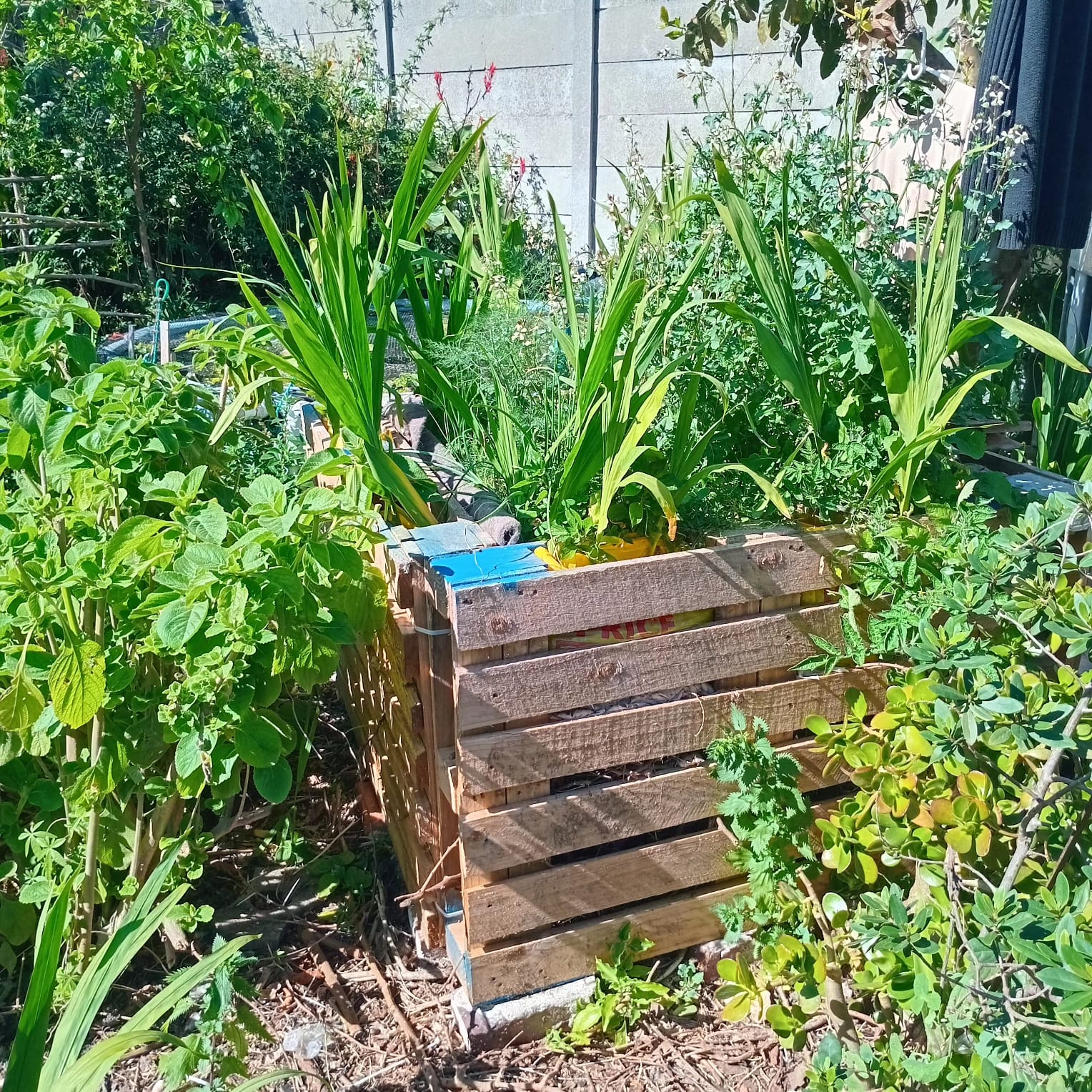 The first pallet bed. Simply cable tied together pallets, assembly very fast, held up well so far. Onions carrots and rocket, left to right, Chasmanthe in the side pockets. But the hollow sides awkward. Its the last of this kind. The others have the back removed.
For the flower or pollinator garden I began with propagating the weedy (aggressive) perennials I have already, that do well here and can provide a skeleton of sheltering plants to be replaced in time. I bought about 11 native plants at a rehabilitation nursery FynbosLIFE in Muizenberg, including 5 restios, beautiful dark grasslike plants of the thatching reed Elegia tectorum. I also bought a tray full of herbs from Hart’s organic nursery in Ottery, choosing them for foliage and flavour, got gifted some attractive and insect friendly ground covers and several other cuttings by my old school friend from her lovely garden in Fishhoek, and most recently I got gifted a lot more plants by a wonderful member of the rehabilitation project I follow and write about. Beyond that I very occasionally succumb to the temptations of stealing, snipping only bits of plants that need trimming anyway.
That is about it for now. I’ve close on 500 plants. It may not be enough and I will certainly add to the diversity and remove the weedier plants that aren’t locally indigenous or edible with time. As the rehab project member emphasized, I need to make sure the fynbos area is very low nutrient. I could rip out plants regularly and remove a lot of nutrients from the soil that way she said. This aligns with 3 zone permaculture, some elements of syntropic agriculture and insect friendly gardening.
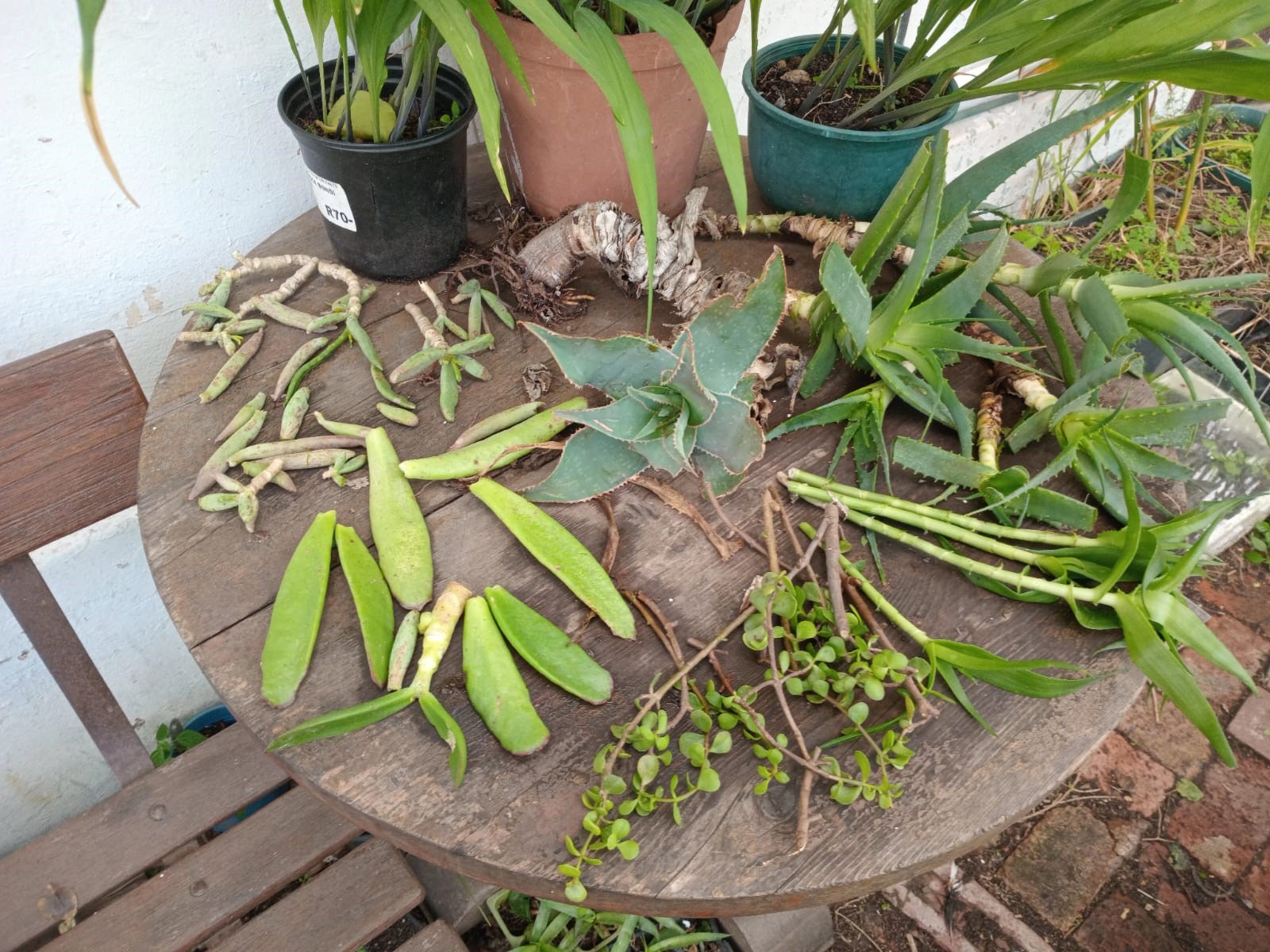 Feverish propagation has been going on over the months of garden creation. Much of it a story of failure, but the succulents have held up. Here are some calousing before the cuttings are planted.
As to its aesthetic style this is very much a cottage garden. My home is a cottage, the garden is small and cottage gardening is really just dense natural planting of an eclectic mix of food and decorative plants with formal elements being only minor accents. There is no grand geometry in my garden. Asymmetry is perforce dominant.
The cottage garden is often an amateur’s garden. I’ve been accused of amateurism, and I’m not ashamed of it. Indeed I’ve the typical scattered, experimental attitude of an amateur. I’ve tried a lot of projects, but only had one garden to test my skills, though I’ve renovated four houses and done very fast, superficial makeovers to those gardens. I work around my husband’s koi breeding operation as he also has to have some fun and make a living. The garden is always full of plastic containers, pond materials and other clutter. My one little garden is like a shore of shipwrecked ideas. It was always a steep steep learning curve in which I often slid out of control back downhill.
So let me get to the diary part of this. I start in June 2026, so you can go there. So far all I've done within the new garden concept is cutting back of our huge Vichellia karoo, planting a lot of lettuce starts and buying and building an experimental vegetable bed with pallets.
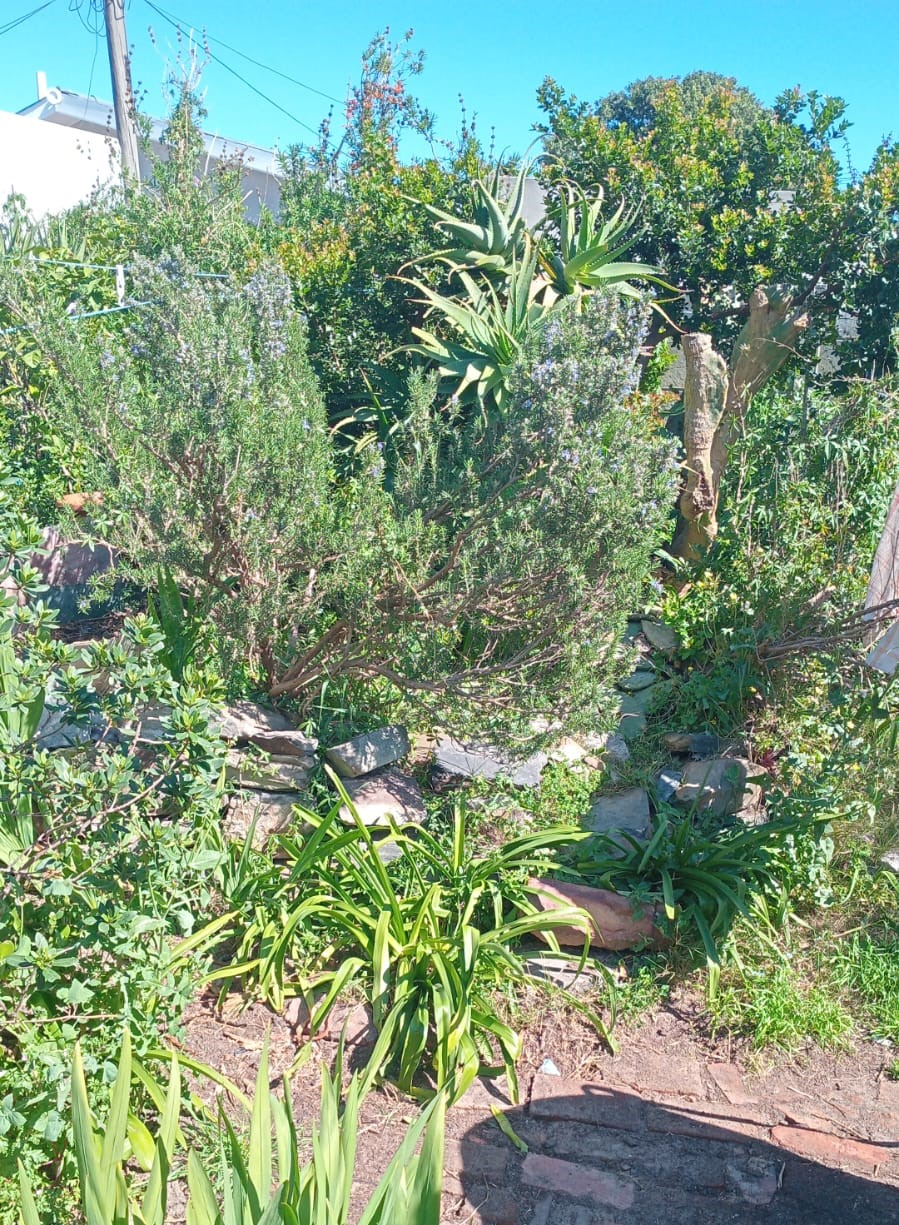 The wild border at the back of the garden is dominated by some aggressive native plants and Mediterranean favourites.
THREE WAYS TO REWARD MY WORK THAT WILL COST YOU NOTHING AT ALL. Dear Reader, in this age of AI created content, please support my human-made content. It requires a lot of research and garden experimentation, aka blood sweat and tears, the last ten years. You pay me back by signing up for the free newsletter (once a month, no spamming) at the top of the lefthand column or below. Please use the response form at the bottom of the page to respond directly to its content. If you find what I give you useful I would appreciate a share to the social media platform of your choice, the buttons are on the extreme right of your screen, Just click them !
Restore Nature Newsletter
I've been writing for four years now and I would love to hear from you
Please let me know if you have any questions, comments or stories to share on gardening, permaculture, regenerative agriculture, food forests, natural gardening, do nothing gardening, observations about pests and diseases, foraging, dealing with and using weeds constructively, composting and going offgrid.
Your second block of text...