3 ways to help the author that COST YOU ABSOLUTE ZERO ! see the bottom of the page.
June 2026
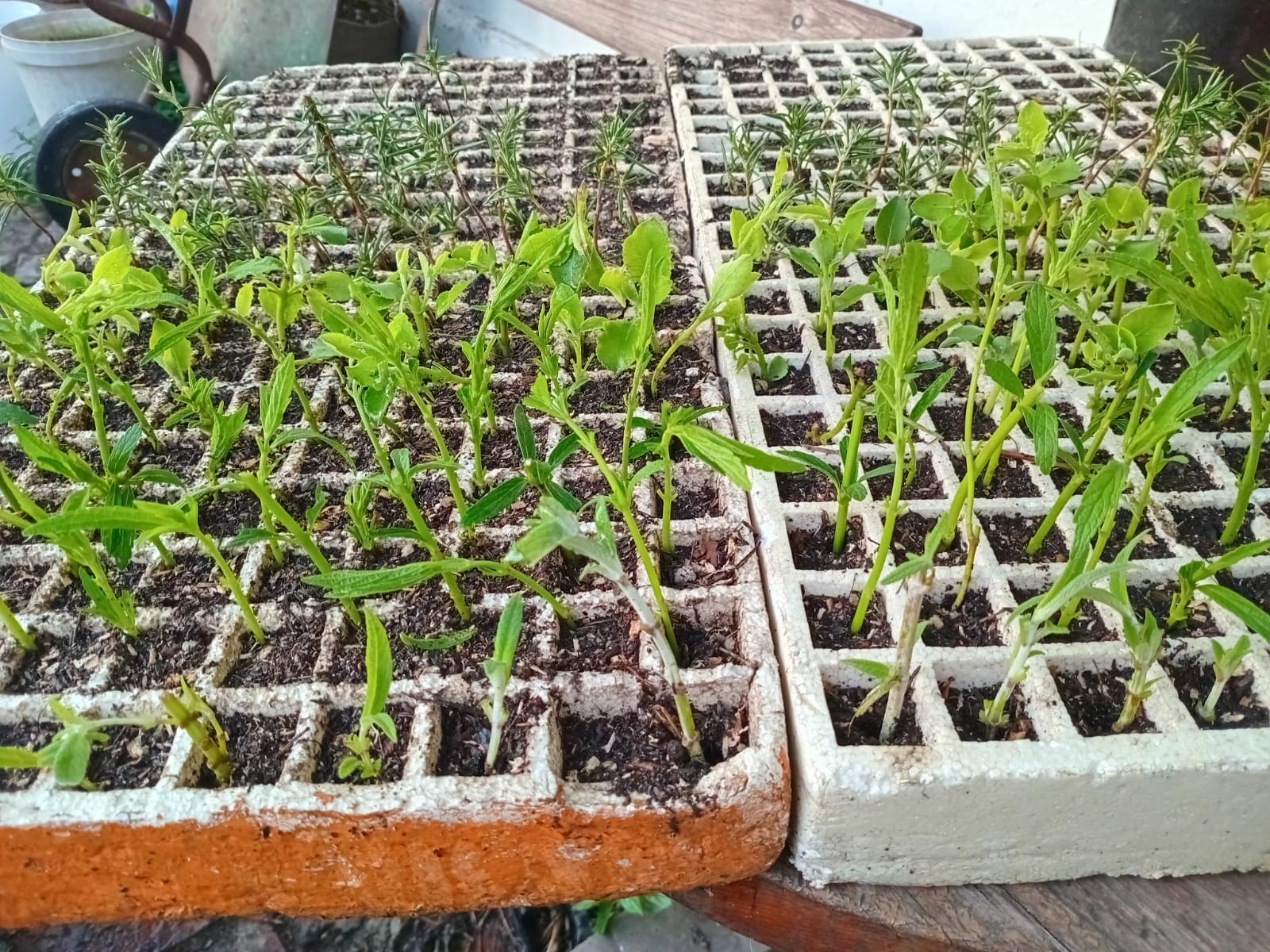 Willow and lentil water cuttings on the left, plain water on the right. The willow/lentil had higher percentages of mould and fewer strikes. The strike rate was about 2%. Myth busting or bad methodology ?
1st
I did cuttings of rosemary, exotic salvia, Salvia africana and Leonotis leonora dipped in a mix of willow water and lentil sprout water as I'd heard both were effective. The 'control' was plain water as a comparison. They were placed in two marked plug trays, under plastic. Its part of an experiment testing plants with natural auxins and antifungal compounds.
7th
On a chilly day I added cuttings of lavendar from a friend’s garden to the two experimental plug trays.
We cut back Brazillian pepper and processed the leaf litter as mulch in my broad bean bed. Cut back the guava tree heavily as its shedding fruit into the fish filters, blocking them and causing water loss very frequently. Researched on the allopathic properties of guava trees and what to do to combat them. All fallen matter should be removed, but in time the organic compounds which cause the allopathy do decay, so I may put the leaves on the compost and burn the wood eventually. The green guavas went into a large flat basket, were chopped up and added to a ferment as they ripen, intended for fruit vinegar, worms and all. (It was bottled on the 24th of August and tasted absolutely delicious though the ferment was very slow and stuck for a while, due to adding too much sugar)
11th
Went to Epping Industria to buy pallets. After they were mounted and roped to the car roof, and they are very heavy, I found out when I went to pay that they were grade B and twice the normal price. They are also very yellow and fresh looking and I don’t like that. I must remember in future to ask for a lower, cheaper grade of well weathered pallet. But I’m nearly done with the pallet beds for this winter at least. My first wooden boxes made last year fell apart the minute I filled them with water and I had to add steel L bends to the corners. The newly converted pallets fastened with cable ties are holding up better. The onions in my experimental box and the 4 kinds of cabbage are looking good. I notice I’ve planted the rows perpendicular to the incoming sun so that the front vegetables shade the next row. There is a difference in the two rows of onions either side of a line of carrots. I must direct the rows towards the sun next time. The mixed plantings look healthier than the specialist onion bed. It is always dry and the tips are crisping, so the balance between shade and too much sun is very delicate in our high UV conditions.
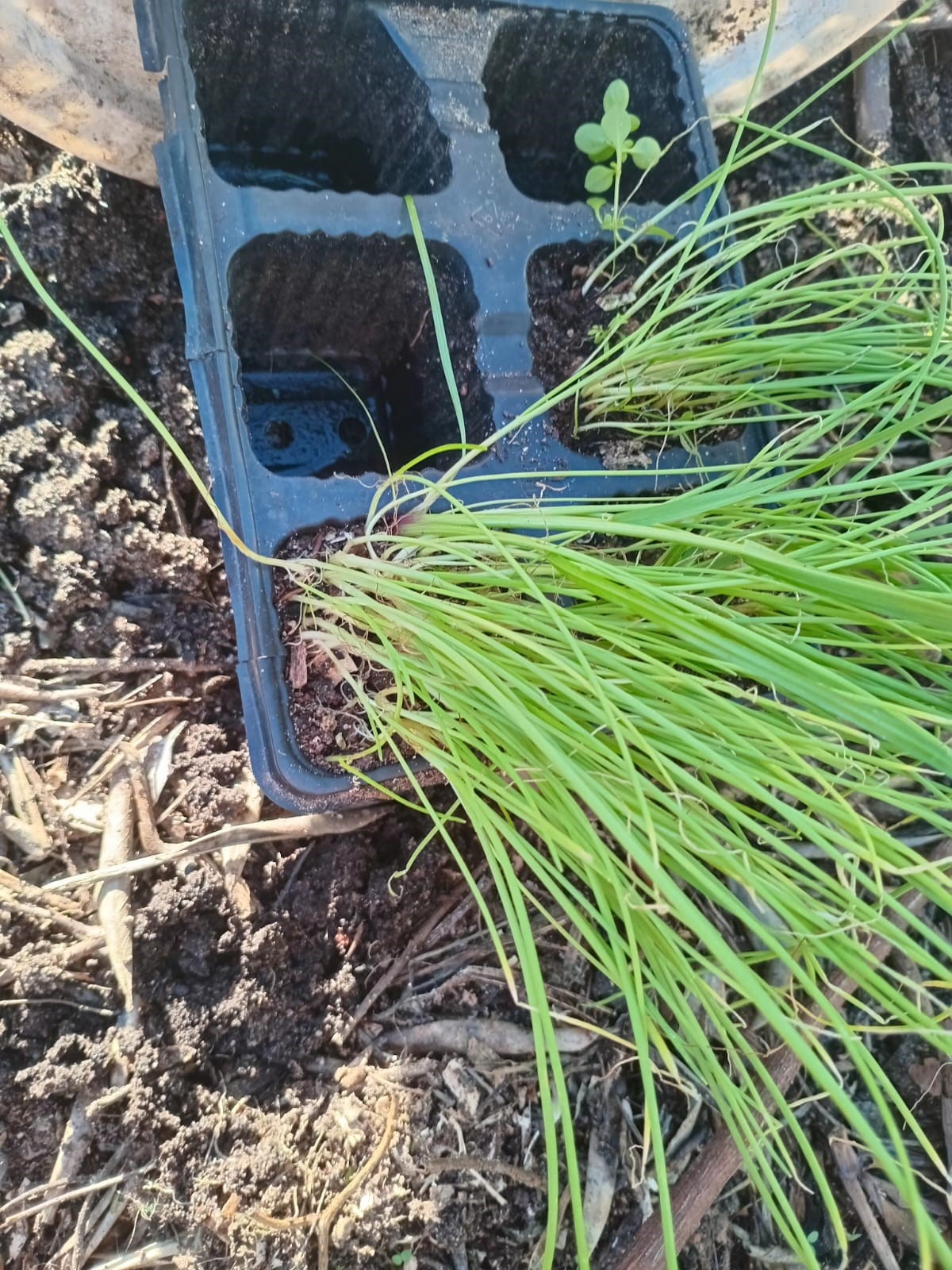 Home grown Texas Grano onion starts. Home grown Texas Grano onion starts. |
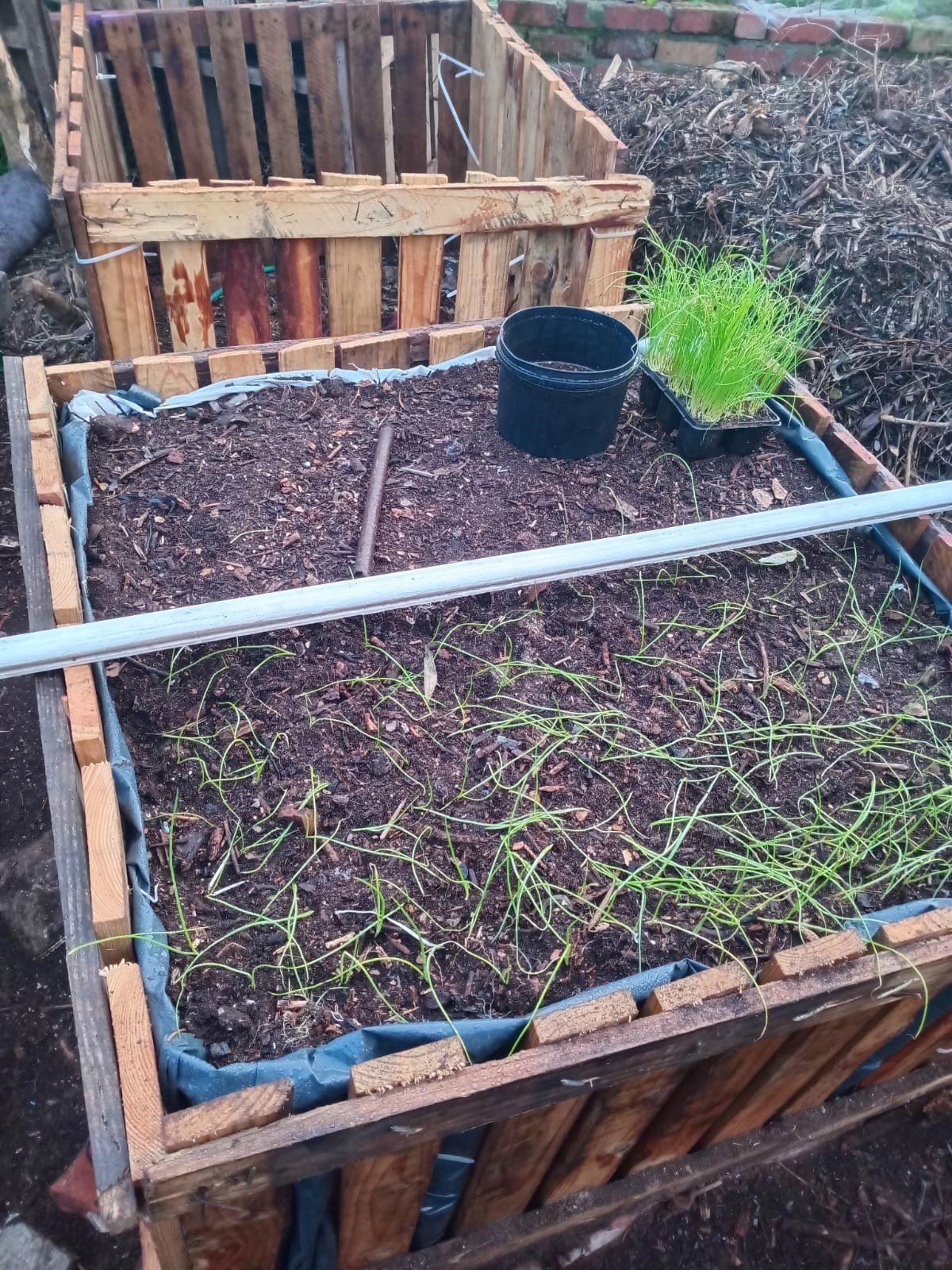 Planting out onions in a specialized bed. Planting out onions in a specialized bed. |
12th
I went to Welgemoed to pick up native plants from a generous donor. On the way pack I found a team digging up the road making huge piles of clay, as Welgemoed is on the clay slopes of the Tygerberg. I was so hopeful. My soil is deep old sea sand 3 meters or more, and the AI told me I would never succeed with some vegetables unless I got clay to mix into the beds. My research indicated that just one 20L bucket per grow bed would suffice, one doesn’t want the soil too dense. I screeched to a halt and asked the team for some clay....Not only did they agree, they filled the bags for me and in return I bought them lunch. It may be the most expensive clay now, but the reciprocity vibes left me with such a warm glow. I came home with a loaded car, with plants that will add a lot to the planned indigenous areas, and I’m ready to finally fill the next batch of vegetable grow beds.
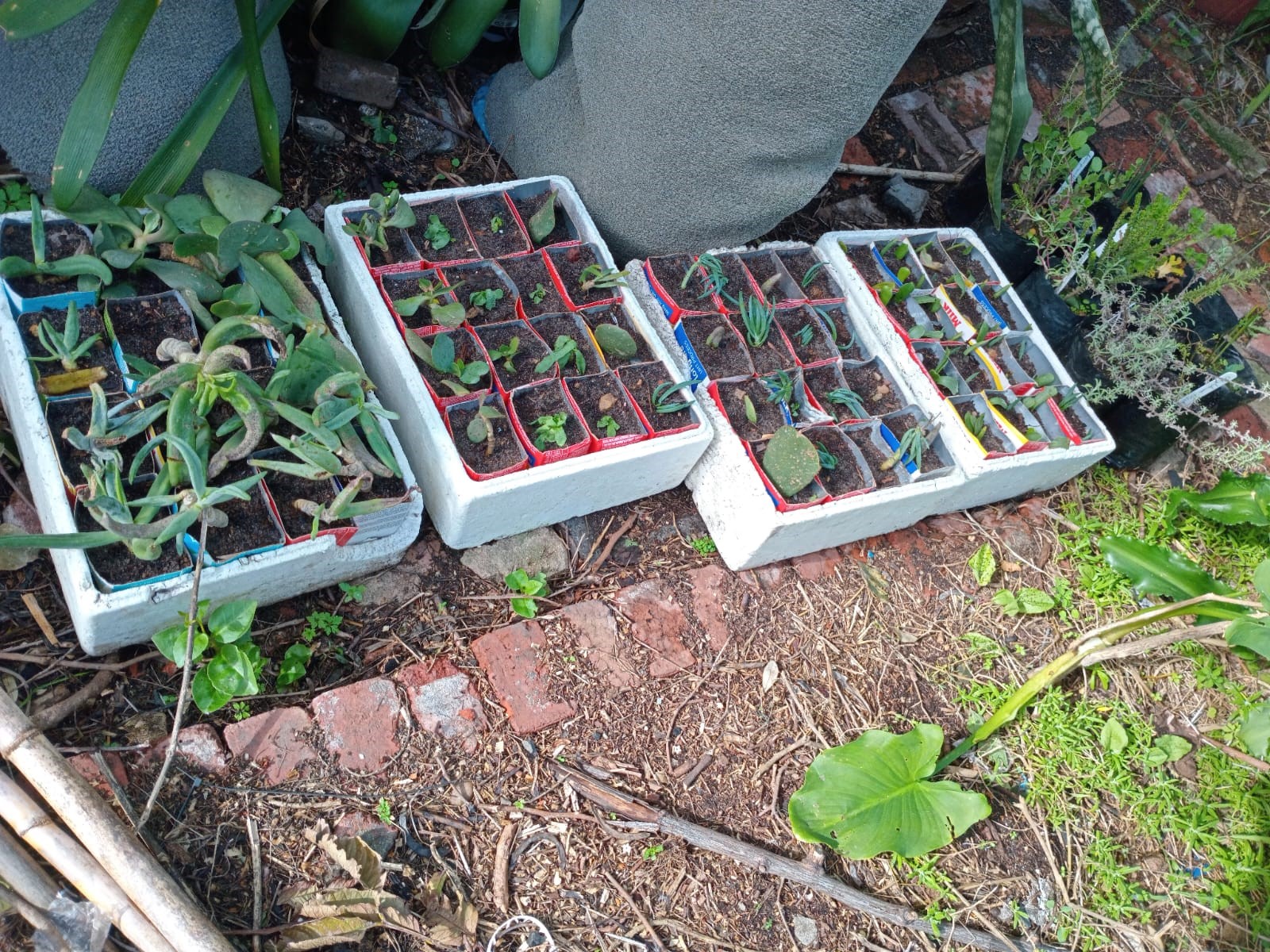 Succelent cuttings in half milk boxes. They mostly flower in winter, good for pollinators.
13th
Put a sack of kelp in blue half drum
I asked Tata George to strip the backs off the crates, fasten on a second mid point plank parallel to the usual ones and then we cut between the two mid point planks to cut them in half. After that he started painting them with linseed oil. I could invest in more of these as the trial beds are working well thus far. They are perfect as I’m not looking for long term permanence, as we may move one day. I'd also like to speed up my experiential learning with structures that are fast to build. As it is, building 6 raised beds has taken months.
If we stay it would be so useful to trial the size, contents and situation of the beds before switching to heavy permanent materials like bricks and mortar. My brick grey water wicking bed has thus far held up the best. It has another advantage, potentialy containing no plastic liner. I’d like to remove its current plastic liner and replace it with a simple mortar lining. However, bricks and mortar are very energy heavy. I use recycled bricks always, and we can minimize the plaster. I’ve read about two interesting ancient low energy plastering techniques that I’ll be trying out when I get to more permanent building.
In the afternoon I put 20% shade cloth over the onions because they have 1cm brown curly tips no matter how much I water. I think the onion bed may be draining too well. With time as the growth became more dense ithe tips have stopped yellowing. Its our dry climate and hot sunlight again.
The cabbages are doing beautifully... springing to life and putting on a new spurt. They are covered with a single layer of tulle.. that fabric used for making ballet tutus, over a frame of bent electrical conduit. It was very hard bending the conduit. I had to heat over a candle and in hot water it to make it malleable enough. Not an advisable material when the curve is too small. The arches are attached to a horizontal square frame. They are joined by the special T and L shaped connectors you can buy for electrical conduit.
The onion bed frame also has arches of electrical conduit but they are slid down onto rods of rebar driven into the earth at each bed corner. The rebar is tied up with wire so it doesn’t splay outward under the pressure of the reluctantly bent conduit.
In the afternoon I clipped up some Metalasia cuttings and soaked half in plain water and half in willow water for four hours before sticking them into my plug trays. Its about the 6th species that have gone into the plug trays, I think they contain 200 plugs each. I should have a lot of plants and hope they will be enough.
Move gifted plants to the back garden in the sun. Most of the propagation is for the 15-20 m2 flower borders I’m planning.
That evening I took the kelp from blue half drum and left it to drain on the paving, emptying the drum on the paving as I can’t use salty water for anything.
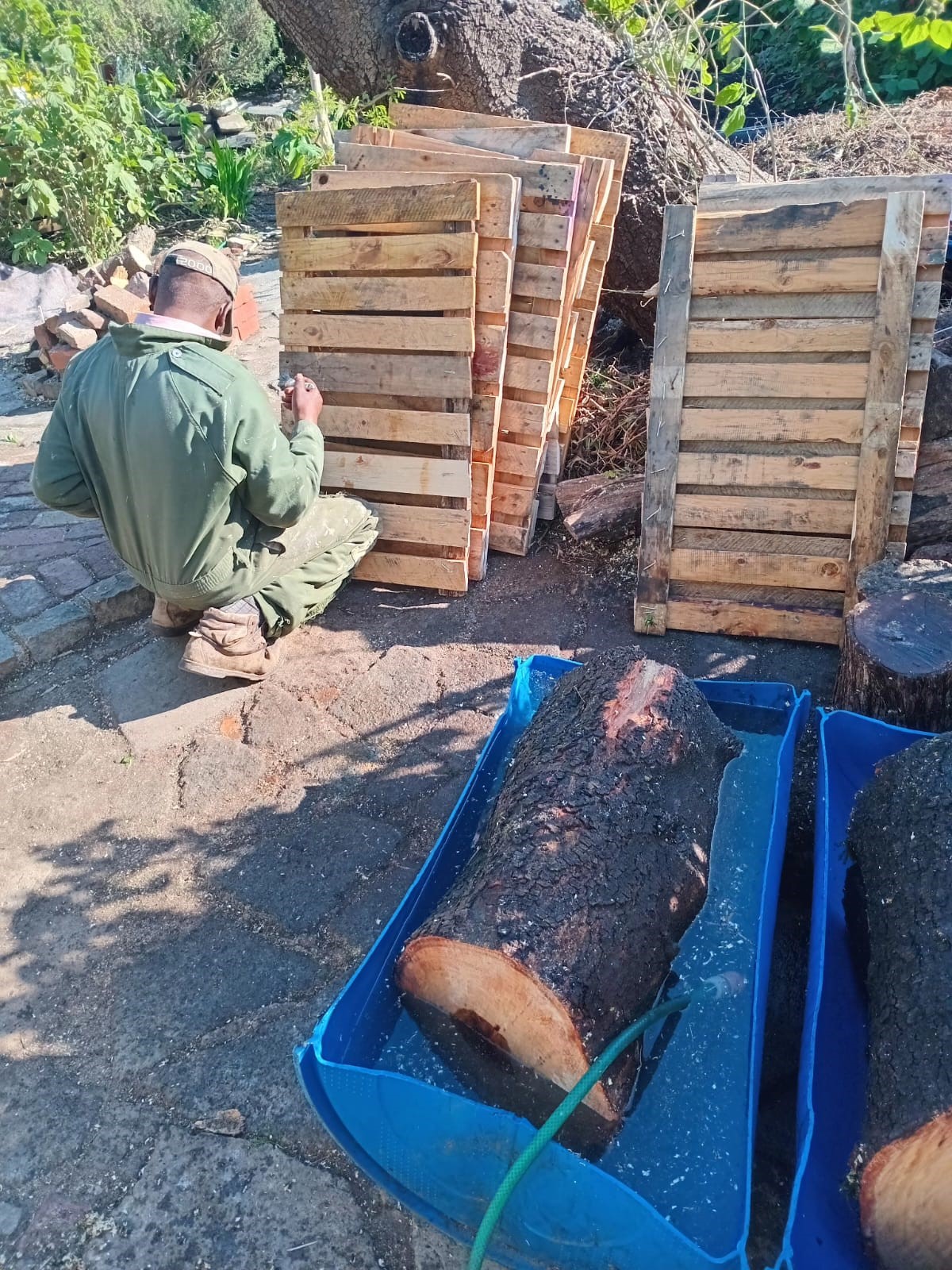 Tata George applying linseed oil to the bed panels he prepared. The massive logs harvested from cutting the thorn tree are curing in the blue tubs to make a mortar.
14th
I took about 3 buckets of biochar I'd previously burned and placed it in a blue half drum. To this was added 20 liters of the smelly water from curing the thorn tree’s massive logs (to make a mortar). The log curing water was then topped up with black very alkaline char water, hopefully stopping the putrefaction there. I added 20L of morning glory ferment liquid to the biochar, 2 Liters of some kind of fruit wine I made ages ago that didn’t turn to vinegar, 10L of kitchen waste, a pile of old papers and the soaked and chopped kelp and stirred it in. Hopefully all the minerals and putrefaction will prime the biochar nicely for next week’s bed building.
In the middle of it all, up to the elbows in putrescent stuff, my mother wanted to tell me about a dream she'd had. She does this every day, and dreams vividly and struggles to tell dream from reality in the first few minutes of waking. I don't dream anymore it seems and I envy her, but also listening to other people's dreams is not that interesting when forced on one at length on a daily basis. She said I must stop what I was doing and come to the kitchen to listen to the dream because it left her in tears. I was pretty annoyed by her demands, and that she wouldn’t wait for lunch as I always sit with her at meals on the weekends and the story could have waited. But she always has to have everything immediately, lives in the moment. Coping with this is part of caring for such an old person.
That night she woke us twice around 4 am, absolutely delirious and very argumentative. I gave her a sleeping tablet which took an hour to kick in so I sat with her till she fell asleep. The next morning she was fine, but I took her to emergency at the local hospital and the procedures there ate up the rest of her insurance for this year and she has nothing going forward. I feel the procedure was not needed as her symptoms had improved with some good rest. Her bloods and test results showed she is extremely healthy.
We have to be on guard against the medical professionals, as carers, as many of them over medicate and over investigate to cover themselves, and others are occasionally negligent, while others are more interested in getting income for themselves than in the patient's financial health. They are just human and experience has taught me extreme caution.
After 10 hours in the queue at the hospital I was sleep deprived and irritated. I wish that the caring role had made me more patient and kind over time, but instead I get more and more burned out from the demands of both my sick people, who tend to think things should turn around them. It seems to happen to the best people when they become ill, its almost a given part of the relationship. I don’t know what other family carers experience. Out there in the caring space online and in the world the expectation of over-weaning concern for the ‘loved one’ and their every comfort and indulgence silences carers. We are so often the last to be asked about our health and happiness. ‘Take care of yourself too’ seems like hollow lip service to mental health mores when there just isn’t time. There must be others who feel this way, especially those caring for a narcissistic family members whose dementia gives them no self regulating and impulse dampening ability, but google searches do not pick up on these carer’s frequency or air their voices much it seems.
Thank God I have a passion for gardening so strong that I make time for it no matter what. Without that time feeling as if I'm moving forward even when up to the elbows in muck I’d be a basket case.
The rest of the Sunday I tried to make up for lost time during the week by doing my taxes, some drawing from a free Proko course, and working on a large botanical watercolour painting I’m doing layer by delicate layer.
16th
Watch one eyed through a sleepless night "Living in the Liberated Landscape" with Larry Weaner https://www.youtube.com/watch?v=3ApuELKd_2Y
Larry Weaner is a lanscape designer using restoration techniques in his own ‘planless’ garden. Clearly I cannot imitate these broad sweeping vistas of wild plants and stands of large trees on his 1/3 acre (1300m2) in my 100m2 space but his techniques have given me food for thought. He researched closely on the self recruitment of native plants from his area and his designing at home consists in supporting this process. I don’t know how the plants that self seed in my garden do so ! Some careful observation of self recruiters, the places they choose and the timing of their emergence with a view to season and succession must be added to my notes on the seasonal emergence of food plants in this garden. With this new set of observations I hope stimulating new lessons will unfold. That one could shift the seed bank back towards native plants with careful management is a fascinating idea to apply to a very much invaded and degraded small urban garden’s soil. Thus far my only native ‘weed’ is the ubiquitous yellow sorrel. I hope the planting of several indigenous species adapted to my soil type will increase the native component in the seed bank. I also didn’t research on the sexual propagation of the plants I bought and they often require cross pollination. This is something I know from most of my indigenous planting thus far, even when there are multiples of one species bought from a nursery, they are often only one sex. Using cloning to create the vast majority of my material for the new plantings is not going to help with cross fertilisation much. I really need to increase my skills with germinating our often difficult local species from seed. That I could even support the recruitment of native species in my garden or manipulate the process for the purposes of design is something I’ve never even considered thus far. I have focussed totally on raising and planting. That is a short term view, without a visionof the process of unfolding.
A lot of vertical sprouts appeared on the elderberry. it was pruned to encourage this vertical growth. I planted a tray of pappaya seeds which had gone mouldy in a closed paper bag, hoping some are still good, but they never came up. Anothe reason may be that they are all GM now.
17th
The lettuces are looking so good. I don't know what I did to deserve it. Bought seedlings at Hart organic nursery and topped up the wicking beds with a thin layer of vermicast. The lettuce in the front bed in the shade are etiolated and floppy and unappetizing looking. In future I have to put lettuce in the sun in winter and in the semi shade in summer.
21st
We built the garlic bed yesterday. Its 2 months too late for garlic but I have cold stratified all the bulbs and they must go in the ground. Had them in fridge for 2 months. I soaked them for 24 hours in 1teaspoon to 1Liter of bicarb to water against fungus. They all sprouted in the fridge which is remarkable, how did they know ?
The bed filling was 20cm of sticks with several buckets of sand watered in. On top of the sticks and sand was a layer of kelp, kitchen waste and biochar which had been fermenting for a week. Then there was old fine humanure compost years old, into which I scattered a bucket of clay as we built. The clay isn’t fine, a bit lumpy. Then 2cm of sand again, 2cm of compost, 2cm of sifted vermicast mixed with 1/2 Liter rock dust, watered in. Tomorrow I intend planting garlic 5 com deep, covering it with 2cm of street leaves, and laying sticks over the leaves between the rows. But don’t know how to do. Oh . 10cm or so .
Thoughts on new design
We're nearly done with the back garden’s raised beds made from pallets. The rest can be built gradually by summer. But that is one a month and they need 3 weeks per bed, so it could take all the time till summer. We badly need to do maintenance work. Hmm..and I wanted to build the pallet fence too. ... when will there be time for maintenance ? I abandoned the idea of the pallet fence and used a very thin bamboo structure.
We will finish some other raised beds and then stop. We’ve a lot of new beds. It would be best to first get a feel for managing them. We will move on with the foundations of the design. The raised bed for cabbages needs one more day. Then we'll start to build the design. At this stage a lot changed. I intended to dig the trench for fertilising and irrigating the fruit trees, to add garden waste as it arises and start the enrichment process for the tree rows. However the long trench with a treeline became two pits which will be filled with organics, like permaculture banana circles but with multiple species. This was due to lack of space mainly.
Regarding the biodiversity of the tree line (now guilds) and indigenous areas, I can add support species, fast growers like tamarillo and papaya, and plant all your saplings later. With time I can add other varieties and diversity and cut back what there is too much of. The indigenous flower borders also need to be added to and continually monitored and augmented. So it will take time. I'm decided on laying the foundation quickly and then get back to garden maintenance. There is a lot of trimming to do, and propagation from seed and cuttings for the new plantings.
22nd
Planted the garlic cloves this morning in spitting rain, finger depth, with a mulch of dry leaves and metal grills over that to keep the rats out, but I've since read they don't like garlic at all. Major reorganization happening at the moment. My sister may not return till mid September and so I asked her carer who is brilliant at tidying things, to help me clean up the house in that time, declutter, while she looks for other employment at her leisure.
I've decided to use the excess of planks for lining the irrigation trenches (idea later abandoned). They should decompose with time and perhaps by then the soil enrichment would have accomplished its purpose and established the line of trees. I will create a to do list for that project so that I can put the activities in an order that will work best.
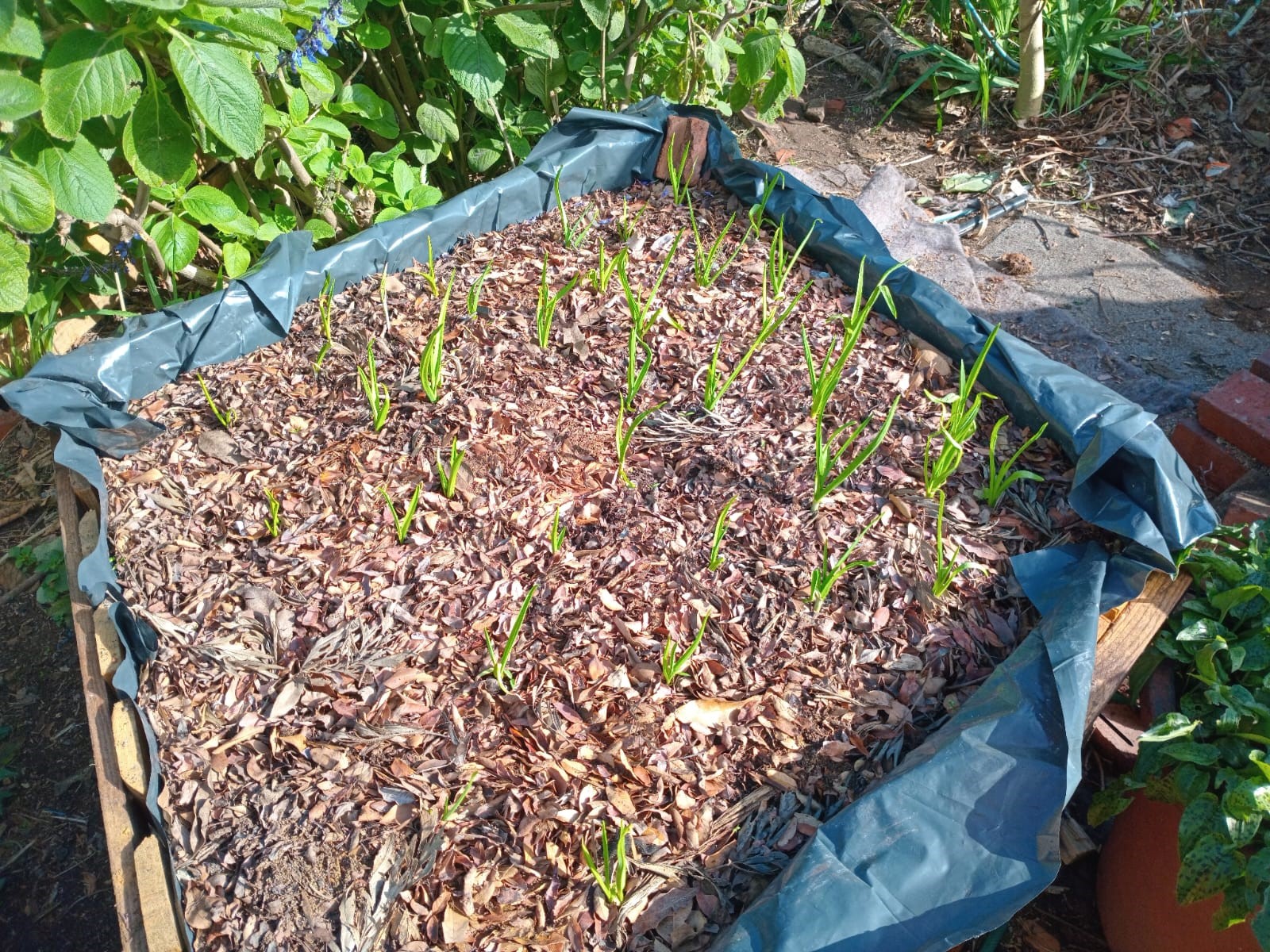 After just a few days the garlic came up. Unfortunately about three of the sprouts succumbed to being dug aside by rodents. The filler sinks so I only tuck in the edges once subsiding stops.
site map with links to all the articles
garden diary introduction and the new plan, its reasons and substance.
THREE WAYS TO REWARD MY WORK THAT WILL COST YOU NOTHING AT ALL. Dear Reader, in this age of AI created content, please support my human-made content. It requires a lot of research and garden experimentation, aka blood sweat and tears, the last ten years. You pay me back by signing up for the free newsletter (once a month, no spamming) at the top of the lefthand column or below. Please use the response form at the bottom of the page to respond directly to its content. If you find what I give you useful I would appreciate a share to the social media platform of your choice, the buttons are on the extreme right of your screen, Just click them !
Restore Nature Newsletter
I've been writing for four years now and I would love to hear from you
Please let me know if you have any questions, comments or stories to share on gardening, permaculture, regenerative agriculture, food forests, natural gardening, do nothing gardening, observations about pests and diseases, foraging, dealing with and using weeds constructively, composting and going offgrid.
Your second block of text...