3 ways to help the author that COST YOU ABSOLUTE ZERO ! see the bottom of the page.
September 2026
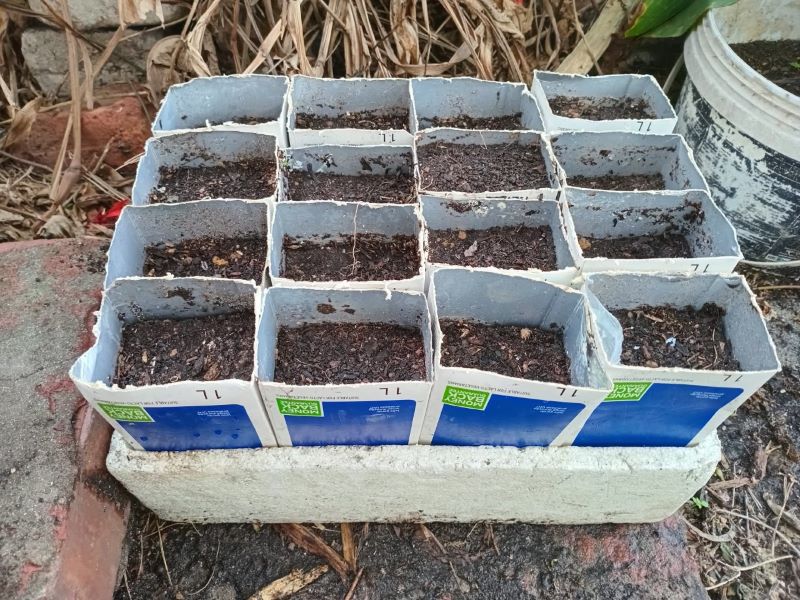 A low cost eco friendly way of raising seedlings in milk boxes. Especially suitable for deep rooted seedlings.
A season of sowing
14th
I harvested some beautiful curly kale. I'd been keeping it for Stephan's return, and it was a couple of weeks past its prime but still very fresh compared to what is generally available instore. I took off about six yellow leaves, but the top still looked great. It has been raining heavily again after a long dry spell. However the broccoli in the same bed has gone over and flowered. I want to expose it to pollinators so I took off the net. In the end nothing came of it. It did not set seed.
Tomatoes that self seeded are about a foot high now, as are the two cucurbits that self seeded. They must be two weeks to a month old. Most gardeners pull self seeded tomatoes and cucurbits as weeds, but I think they can give an early start to the harvest and indeed, they tomatoes were fruiting before our seed sown tomato varieties even got planted out in the beds. As tomatoes like to live in soil that tomatoes have been in I thought there can't be much harm done. I transplanted one cucurbit this morning to see if it works. By november it was doing extremely well. By November the self seeded cucurbit that I did not transplant had climbed up the trellis (with a bit of encouragement) and into the guava tree already.
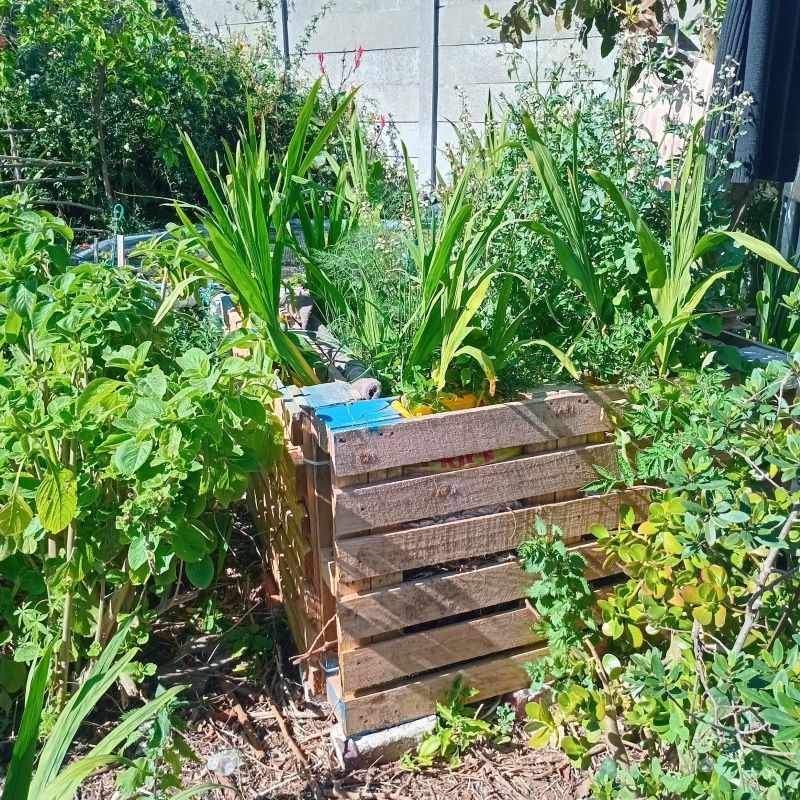 A bed frame built with unaltered pallets and cable ties.
The weeds coming up in the beds are the usual: pig weed, dragon lilies, pellitory at the wall (Parietaria judaica) is everywhere and nettles are numerous this year, although they once almost died out due to over harvesting. Some are already very large and seeding.
This year we had the yellow pavement daisy, Arctotheca calendula, indigenous but seen as a weed by many gardeners. I am not going to pull it, I'm delighted at having my first indigenous daisies in the garden, and especially since I saw a painted lady butterfly laying eggs on one.
The lettuce planted this years is truly over, I mean its bolting, but not seeding yet. I am still harvesting some odd leaves of lettuce off the flower spikes though, and only decided to stop in late October. The carrots are mostly small, pinkie size mostly, but some are decent and even straight. I need to focus on solving their growth sometime in the future. odd leaves, carrots, they small. The dill and coriander are starting to flower but still have plenty of soft green herb. Its been cold, 15 degrees till last week, went up to 19, now its back to cold again.
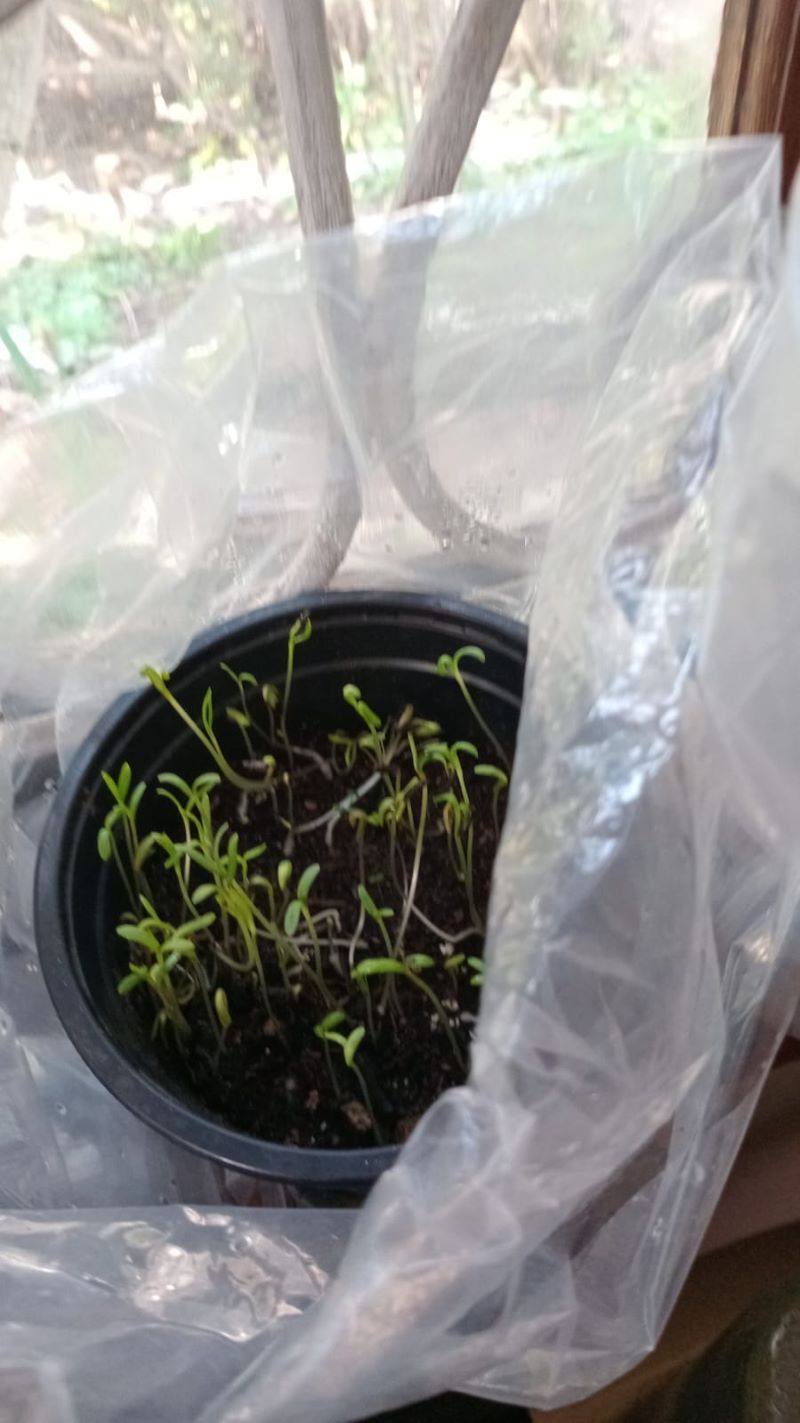 Growing cosmos from seed in a pot in a plastic bag. The germination was good. Later they were transplanted into sixpacks to get ready for planting in the soil.
16th
I soaked some seed for the summer plantings, beans, lettuce and asparagus. The beans were saved rattlesnake, blue peter and green pole beans. Also bought Lazy Housewife and Wellington Wonder. The other seeds were green globe artichokes, asparagus Argenteum, cos lettuce, zucchini Romanesco, zucchini Costa Romanesco, and another Italian zucchini variety without a name. I also soaked maize and tamarillo.
These were soon planted in single pots in plastic bags on the window sill. By the same method I sowed but did not presoak allisum, dandelion, pak choi white stem, marigolds, cosmos, tomatillo and so called African daisy. Weeks later I knew that they mostly germinated, just not the pak choi, sadly, as mom so wanted her own little bed of choi. The Cos lettuce, green globe artichokes and most of the beans planted in trays of sixpacks also didn't come and the Rattlesnake beans planted out direct in the wall beds didn't come.
Into the garden I planted out a tray of Madeira vine Anredera cordifolia to cover a trellis for screening us from the neighbours and to eat and act as a windbreak for the trees around the enrichment pit, and the beans trellis behind that. It is proclaimed invasive because of the dropping bulbils but it is my garden and I weed out all new vines below the trellis. They are easy to pull. I then ferment them in a bucket of water to kill them. We eat the bulbils we find on the vine boiled in vinegar and salt, and I, my 97 year old mother and George the gardener love them. They taste like a mixture of overcooked green beans and artichoke. Quite delicious and apparently anti-inflammatory which is what I really need at 67.
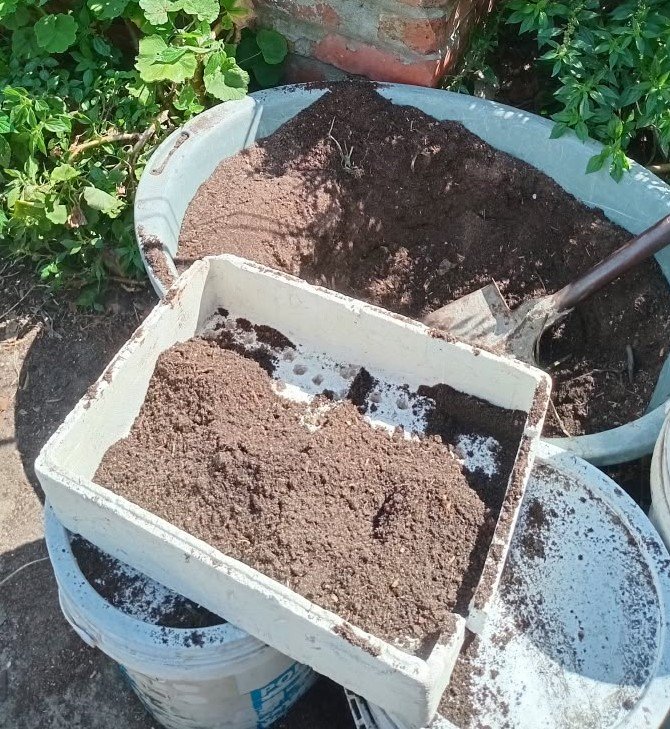 Mixing soil for planting seedlings. My aim is a mix that drains and holds water, with enough nutrients for the seedlings to develop resilient roots before transplanting.
18th
Remove the water from the soaking seeds in the evening. Prepare soil, equal parts vermicast, fibrous organics, old recycled soil and 1 cup of rock dust. I clean and prepare the pots and trays for seedlings and clear space for them. Prepare four trays for beans and flowers and fifteen pots.
19th
Prepare sticky labels for the bags and sow the seeds. The rattlesnake beans and blue peter go directly into wall beds, very thickly sown as I want to get rid of my saved seeds and start afresh. I plant trays with four sixpacks each of green pole bean and blue peter mix, Lazy Housewife and Wellington Wonder.
George chopped the bark off one of my giant logs for making a big mortar for crushing seeds, but the wood itself was intensely hard and spade drills, special toothy bits I bought, called Forstner bits and eventually even embers placed on the surface made no impact at all. Vichellia wood is very tough. I should have known, our Vichellia wood cutting boards have really stood the test of time compared to pine.
Because of the failure of the carving frustration rose. Then we couldn't mix potting soil as the vermicast was to damp for sieving. George started on clearing ivy which was breaking the vibracrete wall. It is pernicious, but he attacked it with gusto. I don't know why I ever planted it. Don't.
Like other garden waste the ivy was chopped very small and went into the enrichment pit.
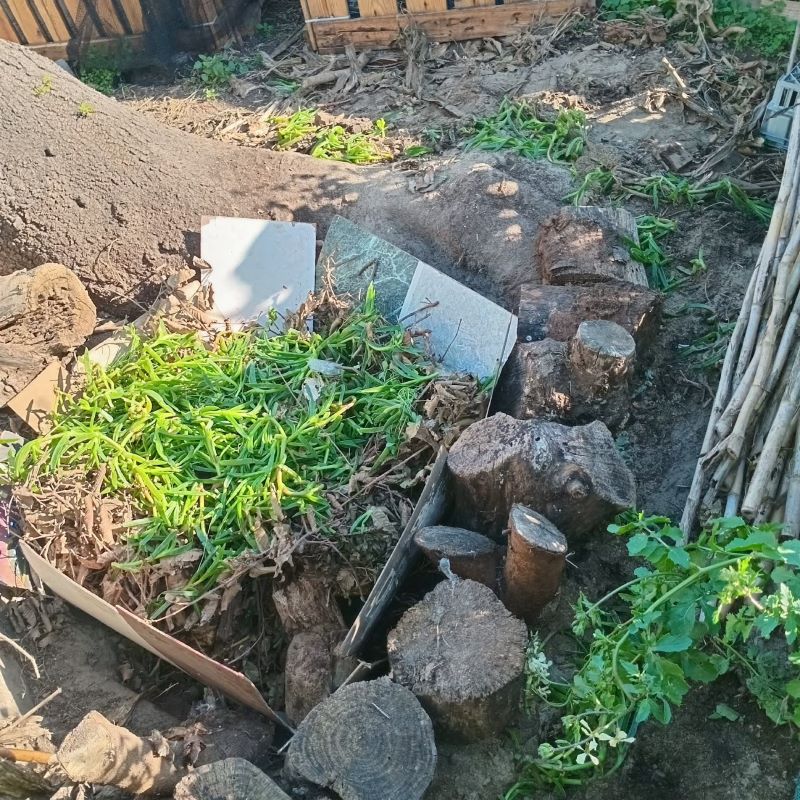 Carpobrotus deliciosus trimmings in long sections were buried here around the enrichment pit to stabilize the edge. They later took well.
20th
I water all the germination pots, make sure their vents are open, move some around to sunnier window sills. Mom's gets dappled sun all day, mine gets morning sun for about 1 hour
Water the bean trays in the shelf.
24
Thus far maize, allisum, marigold, African daisy, Dandelion, cosmos, and some zucchini have germinated. I transplant a foot high self seeded Amaranth, and there are similar sizes of gooseberries, squash and tomatoes a foot long large and smaller to be found everywhere. Though the self seeded squash germinations seem to have slowed down. They were like a rash earlier in the year and I haven't seen a seedling for a while. As you can probably tell, I've started to save self seeded plants and transplant them elsewhere out of curiosity, getting stronger plants and lengthening the harvesting season.
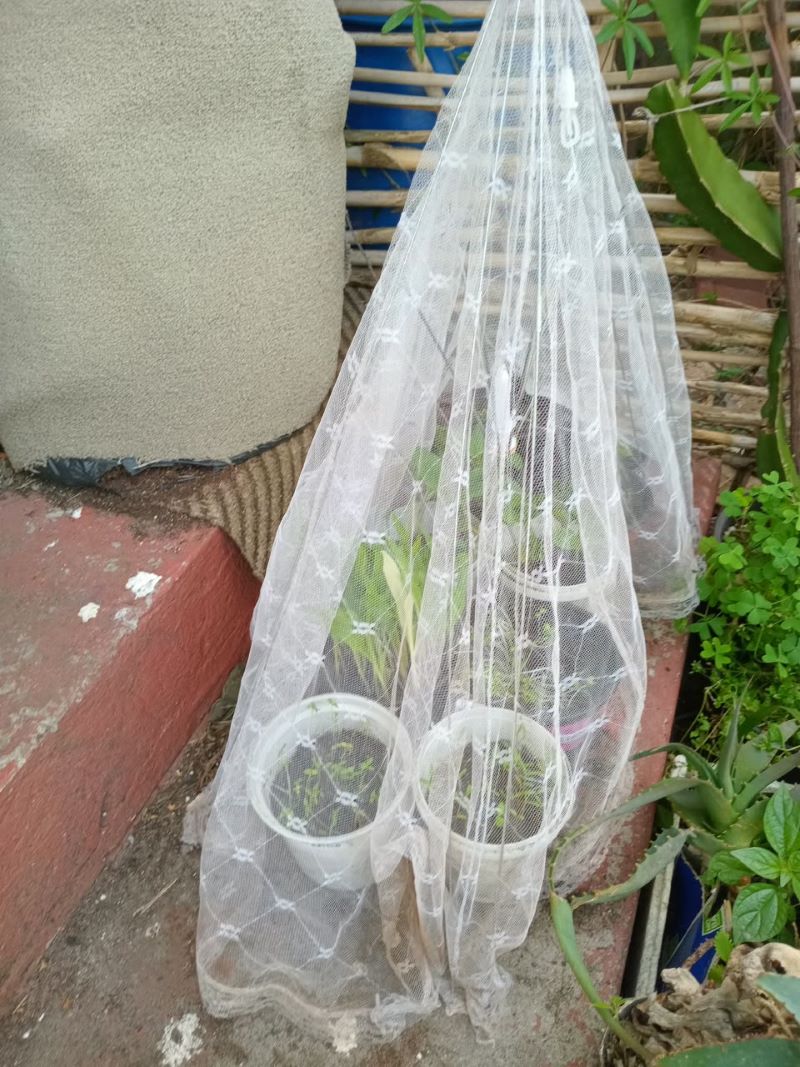 Once germinated the tender seedlings need protection from foraging pigeons. This is a cheap tea umbrella.
26th
I'm did a lot of research on plant combinations in the 18 grow-beds. I decided on the groupings, three kinds I'll list below. I don't have all the plants in the groups and I don't have to plant all of them at all. This is despite having decided on Huw Edwards's recommendation to plant only one plant type per bed, and knowing that even the best companions like the three sisters don't work if you get the timing wrong, but I couldn't fit all the seedlings in otherwise. Onions are especially prone to being shaded out by other more vigorous leafy vegetables. I guess I feel inspired and hopeful because of the cheerful chaos in the long lettuce bed and the tomato bed. In the lettuce bed the exploding rocket, a few lettuce, Arctotis daisies, broad beans and two year old beetroot with beautiful burgundy leaves are thriving together, and some of the best, longest and thickest carrots, and in the tomato bed, tomatoes, coriander. basil and lentils grow with a gay abandon delightful to see. In fact the tomato bed was hot, dry and miserable till I planted the self seeded tomatoes there and suddenly everything began to harmonize and put on leaf. However, weeks later, after the coriander flowered with its glorious white lacy heads, and then drooped, things got a bit tatty, but I'm jumping ahead. This is now as I write, in November. In September and October the combination was glorious.
My planting groups are
Three sisters aligned: zucchini, maize, beans, to which can be added optionally a herby combination of nasturtiums, sage, oregano, and ground covers like sweet potato as an experiment. The zucchini maize did fabulously well in the old cabbage bed. The sweet potato and maize is ok in a low semi shaded bed but not so good in a small raised bed in the drive which gets very dry and drains too well.
The tomato puree posy: tomatoes, basil, spinach, allisum, lettuce, borage, dill, coriander, marigold, 2 with alliums, 3 with beans and no potato or sweet potatoes. The tomato and coriander have as previously described, done very will together. The rest time will tell.
Ghanaian salad: okra, peppers, basil, marigold, lettuce, radish, legumes, no sweet potato or squash. This has not been planted yet, its too early in the summer.
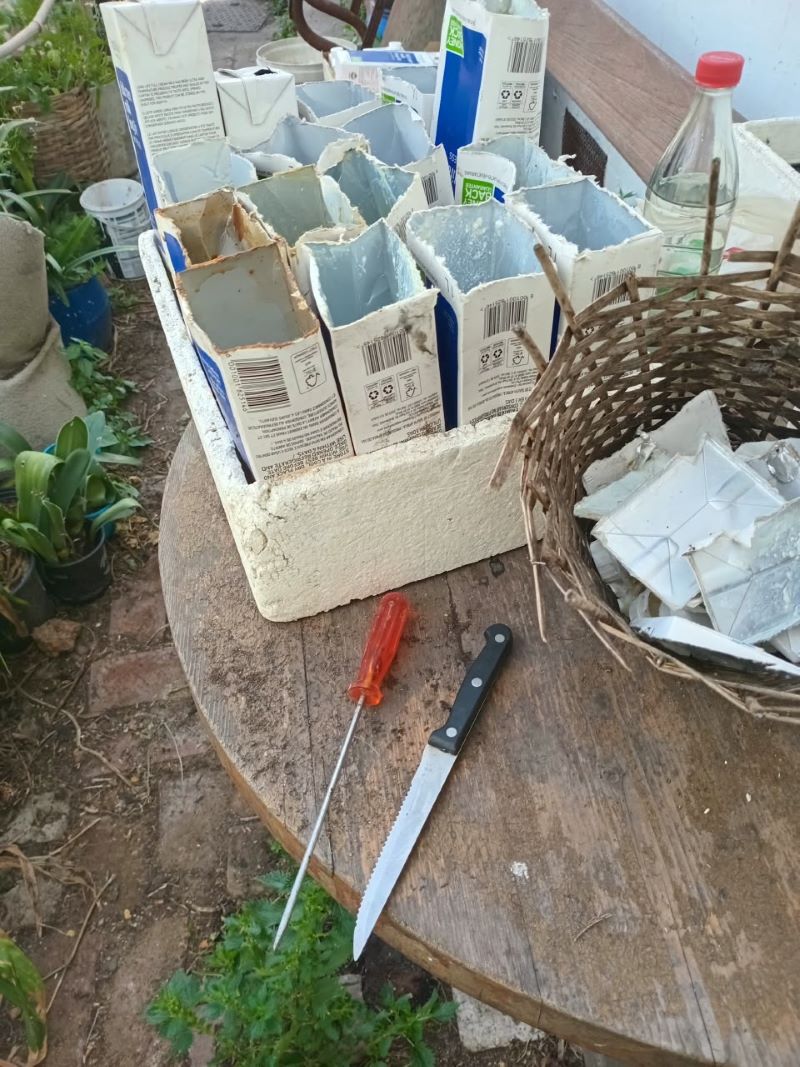 The tools for converting milk boxes to planters, a screwdriver for removing the plastic neck and a serrated knife for cutting off the top of the carton.
Then I hoped to have lettuce and onions together, but the onions are due for harvesting now and I haven't managed to raise any lettuce. Beans and gooseberries is another combination I want to try as the gooseberries are thriving in the bags where the beans used to grow and I wonder if they'd work together. Once the beans have grown tool enough.
These are all my student experiments and learned gardeners may disagree and are most welcome to submit comments.
27th
I plan which of these combinations will go in what localities. Its more complex than it sounds, not only the hours of sunshine must be considered, but what is already in the beds and how many of each combination I need.
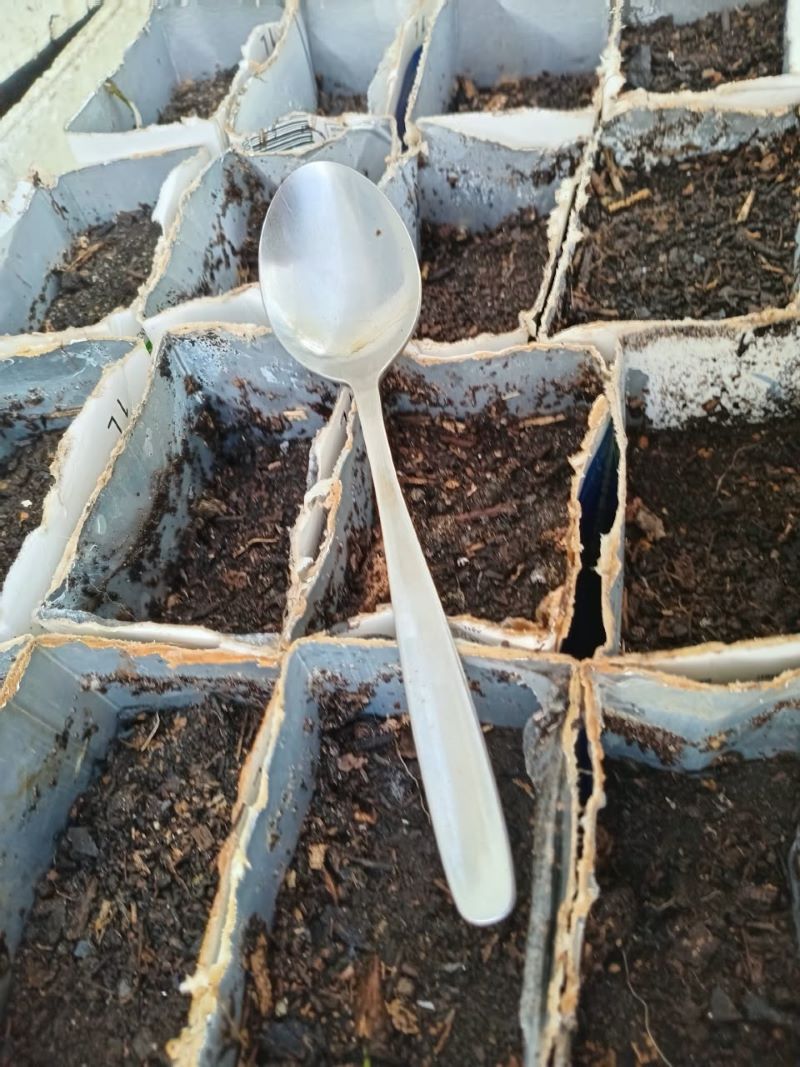 My transplanting tools
28th
I rewrite the plan prioritizing the plant list so I know where each type will go.
Replant my kiwi seedlings again. Something has come up in rows in the tray with glass on it.. I think it can only be what we call pawpaw, and Americans call papaya. It may be tamarillo or grenadilla. By process of elimination I settled on papaya and when they just sat, I did some research and found I'd been keeping them too wet and too cold. After moving to the sun and neglecting the watering they went from two leaf to four leaves in a fortnight. Bingo.
I had planted a lot of broad beans earlier as mom loves them, a whole row, but they aren't fruiting that well. I used some of my own seed and the majority from a food shop. I started sowing again three days ago, to see how far into summer I can push the broad bean sowing. They came up mostly.
Stephan, my partner, tells me I've made huge progress this year with food growing. I'm not aware of suddenly becoming rich in knowledge or skill as he claims. What have I done differently ? I think its mainly the raised beds I built this year, I now have eighteen beds, only two are in ground, and some are rows of sacks. The raised beds are lined with plastic, half filled with old logs and compost, and clay, a twenty liter bucket per cubic meter, but for the first time I used rock dust. Most beds had kelp in them, dry eggshells, a few bones, and lots of organic material. Mixed with white Goodwood sand dug out of the garden, poured down at the bottom of the beds, filling the gaps between the logs and sticks.
I've also paid slightly more attention to sowing times but I'm often still a bit late, and I've been soaking larger seeds before sowing. I also don't try to raise individual coriander and dill plants but sew them en mass. We've even had some reasonably sized tasty carrots for the first time. I did create dedicated beds for brassicas, garlic and onions as Huw Edwards recommended for beginner gardeners. It simplifies things but I've let it get all mixed up again with the planting combinations above.
After some miserable germination earlier in the year with beans and lettuce in sixpacks, I'm sowing everything under plastic bag covers and had very good germination, but soooo lanky its concerning. I'm hardening off the plants which are ready for it today outside under dappled shade with a net over them, against sun, wind, snails and birds.
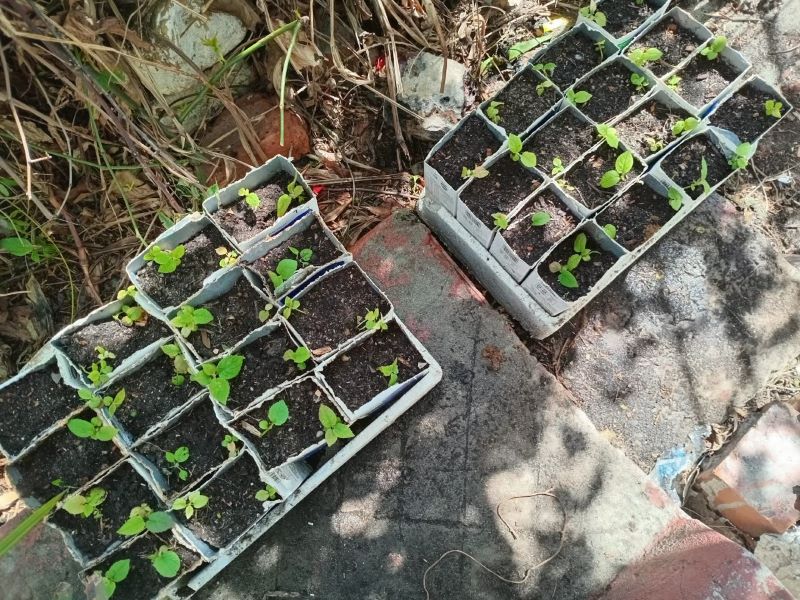 Growing kiwi from seed is not without trials. Thirty odd kiwi seedlings luckily survived the mice.
29th
The kiwi vines in one tray have been dug up by mice. I couldn't work out why then realized that some of the milk boxes I used as planters smell like ripe cheese. I should have rinsed the boxes out before adding soil. When I rinsed after this I had no more digging in the planters. I transplant a lot of seedlings from six packs to half milk cartons, rinsing these first. They look like grenadillas. That is twenty four vines in all. What shall I do with them ?
I Separated the pond net from the canna roots that have grown through it... what a mess, I often just had to cut the net. Better to avoid planting such thrusting plants around the pond in future.
30th
Though I got really good germination in the pots covered in plastic bags, only the zucchini and maize are of any size, and I need to plant them out, planned for this morning, but the rest are small, crowded and very stringy. I think this method has worked well for tomatoes and chillies. Tomatoes handle transplanting directly into the garden very well. I need to build a nursery where there is room for spacing seeds out a bit in trays and covering them with plastic. I find with tomatoes, I can rip them up like weeds and then strip all the leaves except the apical shoots and plant them deep and they have a very high survival rate. In one bed only black tomatoes self seeded. Interesting, but sickly sweet when they ripen to an orange colour.
sitemap for access to all the articles
the Garden Diary introduction and the new plan
THREE WAYS TO REWARD MY WORK THAT WILL COST YOU NOTHING AT ALL. Dear Reader, in this age of AI created content, please support my human-made content. It requires a lot of research and garden experimentation, aka blood sweat and tears, the last ten years. You pay me back by signing up for the free newsletter (once a month, no spamming) at the top of the lefthand column or below. Please use the response form at the bottom of the page to respond directly to its content. If you find what I give you useful I would appreciate a share to the social media platform of your choice, the buttons are on the extreme right of your screen, Just click them !
Restore Nature Newsletter
I've been writing for four years now and I would love to hear from you
Please let me know if you have any questions, comments or stories to share on gardening, permaculture, regenerative agriculture, food forests, natural gardening, do nothing gardening, observations about pests and diseases, foraging, dealing with and using weeds constructively, composting and going offgrid.
Your second block of text...