3 ways to help the author that COST YOU ABSOLUTE ZERO ! see the bottom of the page.
July 2026
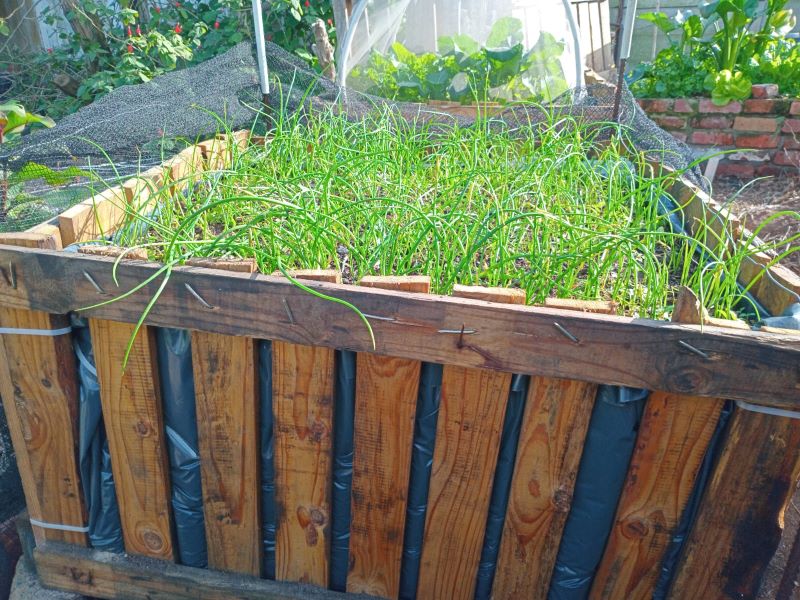 the new onion bed, dedicated to onions, Amish style (apparently). It has worked well but the close planting did not. I will expand in the harvesting article later in November.
I'm still working on the garden only once a week when George comes. Well that is not strictly true. He comes on Saturdays and I often continue on Sundays with more gardening tasks, and then occasionally if something must happen in the week, I do it. This week I collected grass clippings at the park. It only took about ten minutes. Today I stuffed the grass between my onion plants to suppress all the weeds which have responded to the lovely rainy weather.
5th
We cleared and planted the area for the fynbos border, and fenced it in with a bamboo fence. A very light one consiting of vertical and one horizontal. Its just to keep big booted humans out. I had to think a lot to find an area for planting as everything is so used up already.
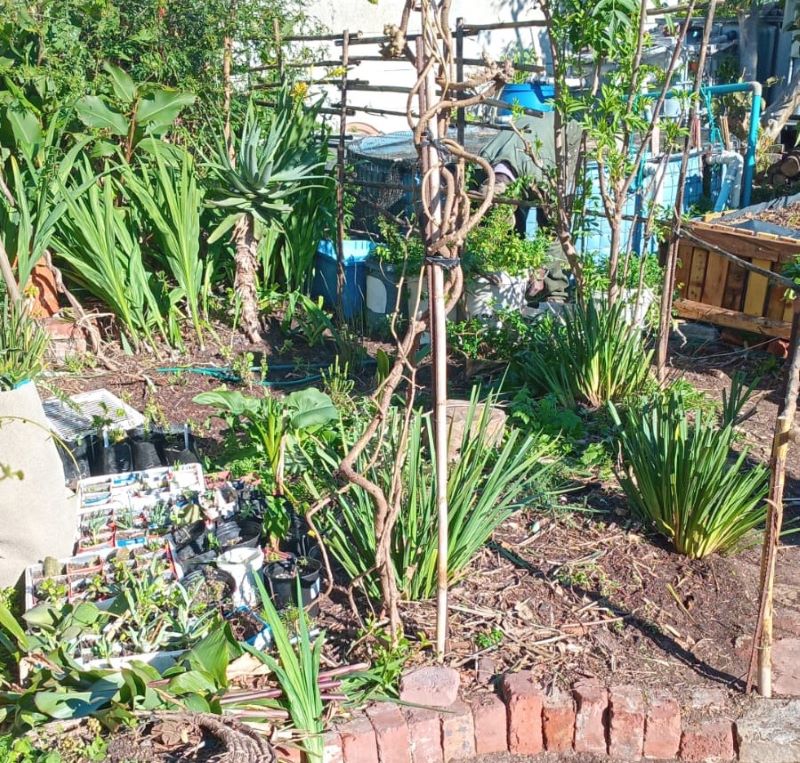 The new fynbos planting surrounded by bamboo fences to keep the people out.
11th
We moved the large planters into position and planted the herbs in them. We also had to make a second bed for the kale inside the long brick bin. Its almost pure vermicast. In the brick bed along the north wall they are perpetually in shade though they have a lot of light. After a slow start they are growing again, if a bit lanky.
12th
I was cooking with rosemary so took the opportunity to prepare about 20 cuttings for water rooting to see if it will work. Some say it does. Must test everything.
13th
Thoroughly tidied the garage, removing all items like nets and plastic sheeting, bags and buckets from the floor and putting them high up on shelves or upside down in the alley. One less place for naughty animals to hide.
18th
We cleared the large heap of Numnum thorns, very old and oxidized, away from an area at the front and put them at the back to be burned. I built a brick box with firebricks and brought my old eye-level oven chamber with its fitting glass door and placed it in the box. It consists of a metal shell and the glass door, placed vertically where it was once horizontal in its life as an oven. Its become a perfect biochar furnace for me. The burning went quickly and the biochar was fine and tinkly, a supposed auditory sign that its correctly processed. When cool it was placed in buckets and covered with fermenting plant juice.
We set up a large raised bed in the gap we'd created by moving the thorns. I'm planning it as a shaded summer bed for lettuce. As mentioned earlier, our beds are built from pallets with the back struts removed, sawn in half and painted with linseed oil. We bind them at the corners with cable ties and thus far they've held up. It is much much quicker than assembling panels from old salvaged wood plank by plank. Those beds took months and are some of the most expensive raised beds in Cape Town.
Huw Richards said in one of his videos for beginner vegetable growers to dedicate each bed to one type of plant. I tried this out and had success for the first time in a decade of experiments. The complex dynamics of competition, allelopathy, soil and water requirements for each different food plant make polyculture very challenging for the beginner perhaps. Even planting in rows is not just a stupid rigid control device, but facilitates a lot of processes like mulching and spacing to let bulbous plants reach their full potential. It took the freewheeling rule hating part of myself a while to learn that spacing and rows has a deep biologically aligned logic...with some plants. Others absolutely thrive. As with so many things generalizing loses a lot of important information.
22nd
I collected grass clippings in the park while walking the dog. I think its safe and no weedkillers have been used as there were plenty of weeds in that corner of the park. I took 3 sacks. That evening I burned the Numnum thorns. It went quickly and relatively well. I like using thorns for biochar as they are slender and the resultant char is fine and doesn't need to be ground up. Its also a way of getting rid of thorny garden waste which can be a headache as it can't go into the compost or anywhere the gardener or animals may hurt themselves.
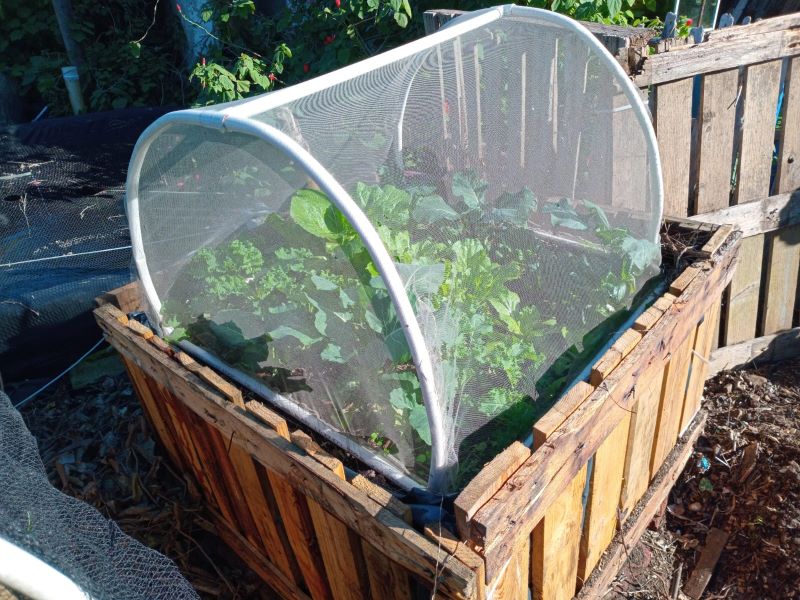 The new cabbage bed. The seedlings shortly after planting. Rodents, birds and cabbage white have been the main detractors
23rd
So the pallet raised beds have been built filled and planted. The garlic bed is doing well, the plants about 20cm high. The onion bed is doing well but the sprouts are very slack, all curving down to touch the ground. Is this because of the close planting ? But this is the same form they took when planted well spread out. The cabbage bed is doing extremely well. I have not tucked in the plastic lining yet because the soil sinks so much, and I'm waiting for this subsidence to stop.
The plants in the fynbos bed are still hanging in there, but one of the restios is slowly yellowing. A bad sign. I find them difficult. The can even take and then just die later. My vision of a Piet Oudolf feel is just, well, a bit ambitious. I will be grateful for the ground being covered and some of the new indigenous plants thriving. My plan for a semicircle of trees growing along a trench enriched with plenty of organic matter is changing. I haven't started on that outer ring yet, and I think its going to consist of 3 pits surrounded by trees rather than a continuous belt because I can't find space for the continuous line of trees.
The masses of cuttings I took have mostly failed. The succumbed to wilting a lot. The ones soaked in lentil and willow natural root hormone succumbed faster. I have not given up on the idea though. I didn't follow instructions.
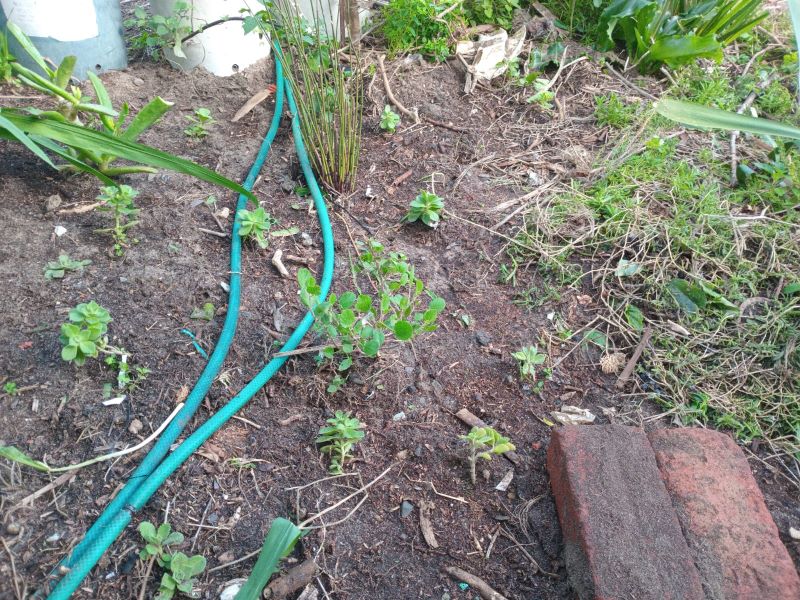 The fynbos looks very sparse but it filled in quickly and needs little watering
In the beginning the garlic bed was devastated by rats. I had scattered some maltebello on the surface as a fertilizer. Maltebelo is a local commercial breakfast porridge based on malted sorghum and it had gone to maggots. Bad mistake. When they finally finished the maltebello, or were driven away by sprinkles of urine, I'd only lost about 2 to 4 of the garlic plants out of 24, so I'm not depressed. My lovely raised bed with dead hedge walls have also turned into a haven for rats. They burrow into the dead hedge and under the plastic. That time consuming bed will have to be ripped out and replaced with a pallet bed soon. I am doing everything I can to discourage and trap them. I'm moving the wood piles into raised metal shelving and getting rid of the rest of the wood either by burning or putting it in the bottom of raised beds. We suspect that some creatures have already been poisoned by a neighbour as we found a dead one floating in a water barrel. Beyond the concern of having them around and the dangers this presents, we are also worried as one dead poisoned rat in our ponds could kill the fish from which we live, and if one of our terriers ate one ….. We bought twelve snap traps, and sanitized the yard, moving woodpiles, clipping away dense vegetation and removing the fruit that attracted them. There were daily sightings, but now I haven't seen one for weeks, nor have the traps caught anything. I hate killing them, but I fear the repercussions from the community and city more. We've never had them before. This is a new thing, but we may be blamed for attracting them because of our organic garden with all its woodpiles, worm bins, mulch, organic brews and compost heaps, and all the food we grow.
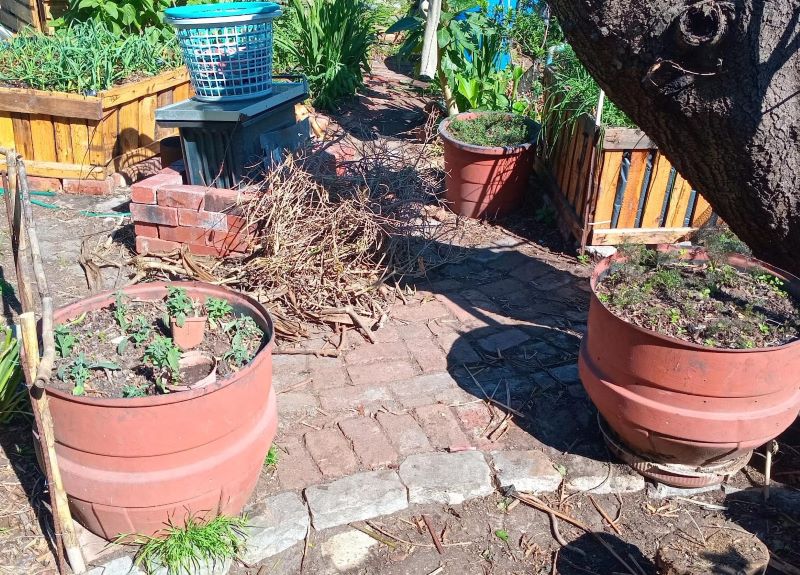 Four large pots of our favorite herbs. They are planted in plastic tubs painted with terracotta stoep paint. I struggle to grow herbs from seed but nursery seedlings did excellently.
After the establishment of the five vegetable beds and six herb planters which were urgent, as I'd bought a lot of seedlings, we are setting up more beds but taking our time, using them to absorb all the remaining woodpiles, biochar and organic material till everything is cleaned up. We are also ready to dig the tree pits, line them with planks and fill them with chopped up garden clippings that will rot quickly. I'm hoping below ground and buried heaps of organics will be less attractive to our furry visitors, offering neither shelter nor food. Cutting back and pruning in the garden is much needed by now, after months of focussing exlusively on building raised beds. The only composter I will keep is a large metal wormery sitting on concrete and perhaps a deep freeze that I will convert into a wormery too. We have a lot of kitchen waste that I can't put on a compost heap.
garden diary introduction, the new plan and its reasons
THREE WAYS TO REWARD MY WORK THAT WILL COST YOU NOTHING AT ALL. Dear Reader, in this age of AI created content, please support my human-made content. It requires a lot of research and garden experimentation, aka blood sweat and tears, the last ten years. You pay me back by signing up for the free newsletter (once a month, no spamming) at the top of the lefthand column or below. Please use the response form at the bottom of the page to respond directly to its content. If you find what I give you useful I would appreciate a share to the social media platform of your choice, the buttons are on the extreme right of your screen, Just click them !
Restore Nature Newsletter
I've been writing for four years now and I would love to hear from you
Please let me know if you have any questions, comments or stories to share on gardening, permaculture, regenerative agriculture, food forests, natural gardening, do nothing gardening, observations about pests and diseases, foraging, dealing with and using weeds constructively, composting and going offgrid.
Your second block of text...