3 ways to help the author that COST YOU ABSOLUTE ZERO ! see the bottom of the page.
SOME FOOD GARDENS IN UGANDA
As I explain in the Newsletter, last year I went to Uganda to meet the editors of the book on Agroecology and African Food Activism I would be illustrating. I got a much better understanding of the environment and the feel of the kind of places mentioned in the book from this experience. We stayed at a resort on Lake Victoria that was an artist’s paradise, with very quirky hand made style in all its buildings and decoration.
 Garuga Lakeside Resort in Entebbe, Uganda, is an artist's paradise.
The garden of the resort was exceptional. The terraces on the lake consisted of smallish lawns of intensely green broad leaved grass bordered by palm trees, bamboo hedges, many many varieties of hibiscus, decorative gingers, Nandina and euphorbias.
 |
 |
The flowers and leaves of a gorgeous 6 meter high hibiscus tree growing in the Resort garden. The flowers start off yellow and slowly turn sunset pink when they fall onto the ground.
On the upper slopes of the garden were giant trees whose immense trunks were covered with Monstera vines of 3 varieties that grow all the way up into the canopy. When I found out how much a single small Monstera plant costs in Kampala this represents a green fortune. Between the forest trees, Philodendrons of diverse varieties carpeted the ground. The head gardener grew many of the plants himself and much of the planting except the forest trees seems to be a decade or so old.
 There were 3 varieties of Monstera vines which grew all the way up the tallest trees.
It was a haven for wildlife too. At night there would be loud thunks on the roof. I did see Vervet monkeys, a troop of about a dozen near the lake shore early one morning, sitting on top of the garden walls. However, as I grew up with Vervet monkeys in the eastern Cape, I don't think all the thunks were monkey business ! I think a lot of it was due to dead twigs falling from a great height from the overhanging trees. On the lake shore after sunrise there would be different storks and egrets or herons. I didn't get close enough to photograph them for an ID. There were also cormorants basking and what they call hammerkop in Afrikaans or hammerheaded birds, Scopus umbretta. Other members of our party commented on the morning song of birds and the quiet days. It was intensely quiet, far from traffic noise and even planes at Entebbe airport didn't intrude much.
 The quiet water on lake Victoria seen from the lawn of the resort
There are many times I walked on the red clay road in the early morning past a grove of huge jack fruit trees to see the farm plots in the vicinity. I saw strange things, like Cassava seeds, small round five sided pods with a hard shell. A Zimbabwean farmer who grows cassava told me he had never seen a cassava seed. Its just further evidence of Uganda's ideal growing conditions for such crops.
 Cassava seed seen from tip Cassava seed seen from tip |
 Cassava seed seen from side Cassava seed seen from side |
The farmers had mounded the earth into little hills about 70 cm in diameter and 30 cm high. Sweet potatoes were growing on these mounds. There was a lot of organic material mulching with crop residue and trimmings, and many compost piles. Animals like goats and cows were an ubiquitous part of the gardens.
 well mulched banana grove well mulched banana grove |
 earth mounded for sweet potato earth mounded for sweet potato |
There were fields of Cassava, bananas of various kinds, magnificent taro plants and many wayside plants that included some wild cucumbers or tiny squash, a scramble of flowers, elephant grass and vines grew on the verges. On our walks in the area we saw more types of ginger one a massive clump with shiny red flower heads. Mulberries have gone wild along the lake and they seem to be of a unique variety with huge glossy leaves born bilaterally at the end of naked branches.
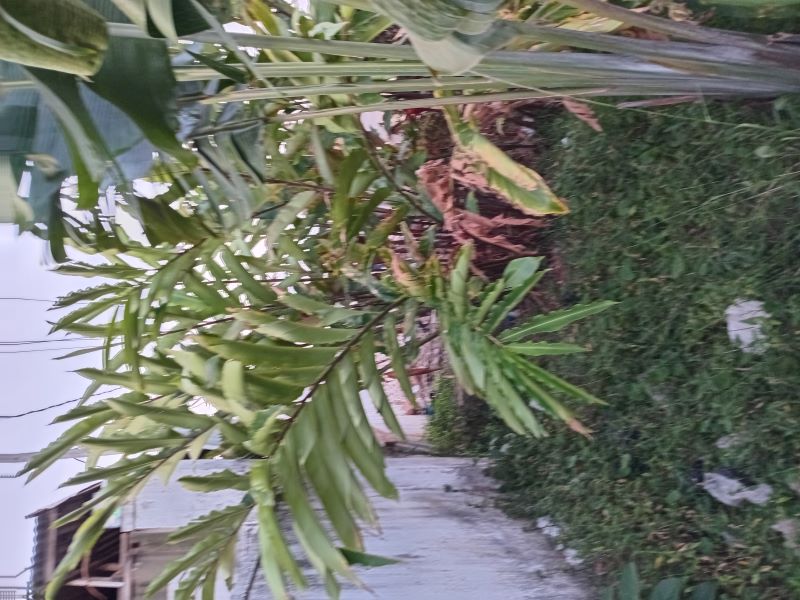 A massive 3m high ginger variety growing by the wayside A massive 3m high ginger variety growing by the wayside |
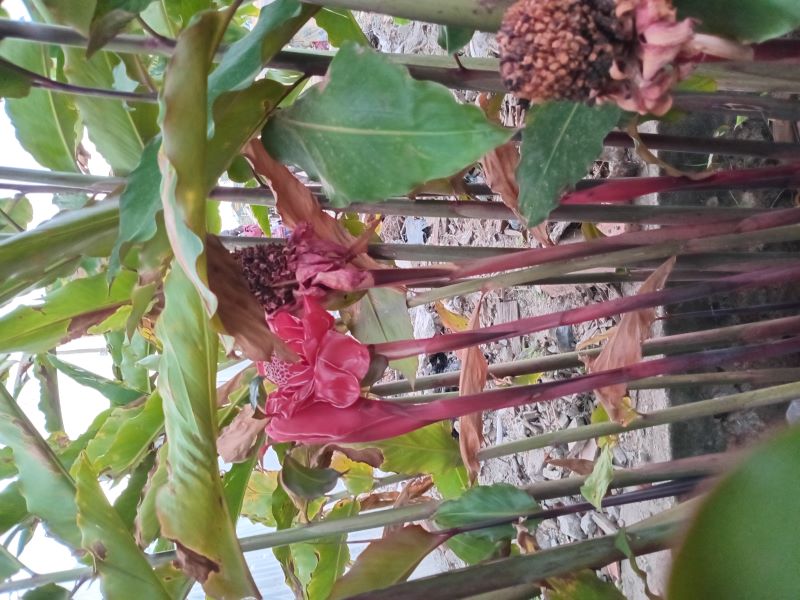 it had a shiny red flowers shaped like a protea it had a shiny red flowers shaped like a protea |
A time came when some of us just had to see the local markets. I was so happy to go along. As I touched on in the newsletter, Entebbe just had food gardens everywhere. I found this so wonderful and remarkable, but my uncle who has spent a lot of time in Cameroon told me that country also has a lot of gardeners. Perhaps it is only in South Africa that we are less interested, otherwise every verge and park in the city would be bursting with green produce. Maybe we are prevented by our drier climate which is less conducive to vegetable gardening,
 A food market in Entebbe close to Kampala, Uganda.
At the market the produce was very low priced and the vendors looked like they work really hard for a living. I've sold at outdoor markets and I know how tiring, hot and disappointing a day can be. Selling products which can spoil in the blistering sun must be hard. We were accompanied by Charles who is an expert on African regional markets, having visited them for his research from Durban in South Africa all the way to Tunisia. He was able to explain some of the dynamics we saw.
For example as everyone in Uganda who can, will grow their own food, the market women outside the city centre may struggle to sell some types of produce and need to specialise. I bought some dried hibiscus tea pods. They make a delicious red tea. The tiny finger length bananas are also delicious. Their banana flavour and creaminess is intense compared to the Cavendish we're used to in the rest of the world.
 A diversity of beans sorted and cleaned by ladies at the market in Entebbe.
I hope that the determined activism of many will lead to local governments giving more support to the regional markets. All over the world they are one of the greatest parts of local food culture. Much needed in Uganda is cold storage to combat spoilage, and processing like drying, preserving and milling that adds value and a competitive edge. The organic farming which is practically a default form of production has to be branded as something of value also. Many markets are engaged in an uphill battle competing against the huge corporates for whom Africa is a new frontier of expansion for malls and supermarkets.
The tropical fruit in Uganda are abundant and delicious and full bodied in flavour. We had fruit slices, pineapple, watermelon and fruit punches at every meal. We also had Nile perch and Telapia from the lake, deep fried and crispy, and wonderful bean stews prepared by expert cooks.
 A fishing boat typical of the artisanal net fishing on lake Victoria.
I often watched the fishermen who plied the water around the shore with their nets. They never sat still from dawn to dusk, throwing out the net, and then gathering it in again bit by bit, and throwing it again. Most of the time the boats on the lake shallows are one or two man wooden boats with an upward sweeping prow. One day we walked down to the part of the lake shore where there was a landing strip for fishing boats, massive wooden ten person boats with the characteristic form that is so beautiful.
Is Uganda, or the whole of Africa a blue zone ?
I had many conversations with a member of staff at the resort called Yasin as he was very prepared to engage in interesting conversations from which I learned much. He told me about his grandfather who lived to be 115 and the many other people in his family who became extremely old.
On principle Yasin’s grandfather never drank boiled water, only well or tap water. He bathed in water so hot it was barely tolerable. He never ate food cooked in metal only in clay and avoided modern foods such as processed or tinned foods. He never ever took pharmaceuticals, even for malaria, only herbal remedies, he walked everywhere, standing very erect with shoulders squared and he wore the traditional wooden sandals with a stick between the toes, and no sides or back.
My thoughts on all of this, and experience from research on caring for my 95 year old mother are the following: Grandfather's toes had to grip that wooden sandal's stick, and his toes remained strong, preventing loss of proprioception and balance so common in very very old people. His good posture would also prevent falls. His walking kept him healthy in many ways. The hot baths possibly caused hormetic stress and mitochondrial genesis, maintaining his energy levels if I'm to go by integrated medicine theory. His choice of food meant he avoided metal contamination in any of it, as well as avoiding all the degenerative diseases caused by consuming too much sugar, carbohydrates and bad fats, colourants and preservatives. The organic food which is the norm in farming societies there would ensure he was well supplied with macro and micro nutrients and life prolonging phytochemicals. His avoidance of pharmaceuticals meant that he didn't tax his body with side effects or toxic ingredients. The plant drugs he took were a huge phytochemical boost probably full of anthocyancins, and other good stuff.
I cannot explain grandfather's rule about unboiled water. Perhaps it helped with the avoidance of heavy metals. Perhaps boiled water is 'dead' and the unboiled water helped sustain a diverse microbiome, but he was getting so much of that from his food choices it scarcely makes sense. People like him should be studied.
The study of centenarians in blue zones is such a big part of the research into diet and nutrition and has lead to the 'Mediterranean diet' being so popular with dieticians. It is time for the blue zones in Africa to be studied and visited as health destinations and the indigenous crops given their rightful place in health practice. We may all soon be trying to imitate various traditional African diets to live longer. There certainly are a lot of regional variations to choose from !
home page for links to my network of articles on gardening
THREE WAYS TO REWARD MY WORK THAT WILL COST YOU NOTHING AT ALL. Dear Reader, in this age of AI created content, please support my human-made content. It requires a lot of research and garden experimentation, aka blood sweat and tears, the last ten years. You pay me back by signing up for the free newsletter (once a month, no spamming) at the top of the lefthand column or below. Please use the response form at the bottom of the page to respond directly to its content. If you find what I give you useful I would appreciate a share to the social media platform of your choice, the buttons are on the extreme right of your screen, Just click them !
Restore Nature Newsletter
I've been writing for four years now and I would love to hear from you
Please let me know if you have any questions, comments or stories to share on gardening, permaculture, regenerative agriculture, food forests, natural gardening, do nothing gardening, observations about pests and diseases, foraging, dealing with and using weeds constructively, composting and going offgrid.
Your second block of text...