3 ways to help the author that COST YOU ABSOLUTE ZERO ! see the bottom of the page.
Caterpillar Food Plants for Fynbos
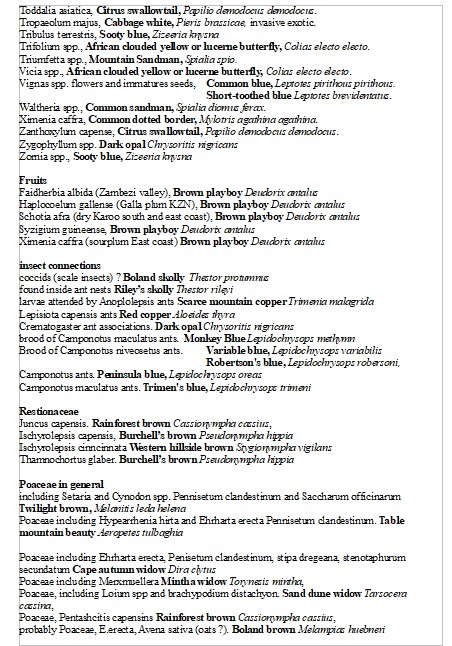
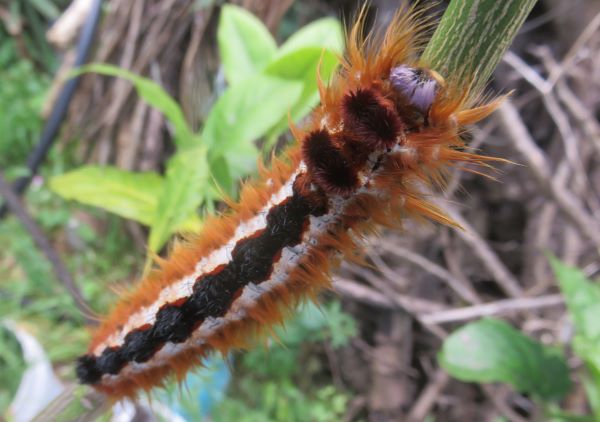 20 years back Lappet moth caterpillars used to annoy me. They would cluster in colonies on our hibiscus or Vichellia plants. I have not seen them in years.
The unloved caterpillar that eats 'our' plants is the hero of this story and I'm encouraging gardeners to support the humble caterpillar in their planting decisions and not make it an enemy.
When wishing to support butterflies, it is very important to provide for the caterpillars. It takes many caterpillars to produce a butterfly as the fat soft larvae are so often prey for other animals and birds. This is why I've gone about researching the food plants of caterpillars, or the larval stage of butterflies, as we need to 'make' a lot of them to have butterflies.
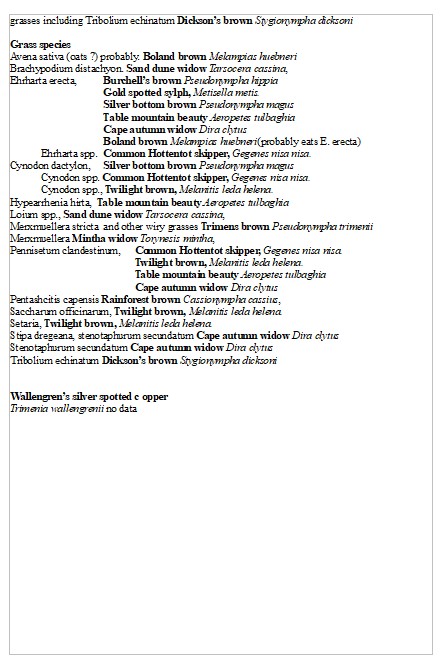
During the process of compiling the list I noticed some interesting trends. Many butterflies have a handfull of larval host plants, but the host plants as a rule have only one caterpillar herbivore. It is a lock and key relationship, and in the Fynbos it is very tight.
This is so different to what Doug Tallamy describes in north America, in which one oak species is the host plant to hundreds of caterpillar species. In fact our situation at the Cape seems to be the complete opposite. The importance of key species in the ecosystem is the basis for Tallamy's idea about keystone species, that with one plant you can support so much insect diversity. Conversely in the Fynbos areas we need astronomical plant diversity to support insect diversity, at least where butterflies are concerned.
The butterflies in this list may have a very wide or small range. Those found in Cape Town may be found elsewhere, depending on the species, and hence not all the host plants are specific to Cape Town. I have included indigenous plants from the rest of South Africa if they were mentioned in Woodhall, who wrote the most marvelous collection of South African butterflly books.
This list still needs a lot of work, and has taken a lot of work. The next stage would be to narrow down the plants to those found in the city and peninsula, and perhaps after that to select those plants found in the potential natural vegetation and veld type of my own garden and grow those plants. This is a work in progress so forgive me for sharing unfinished material.
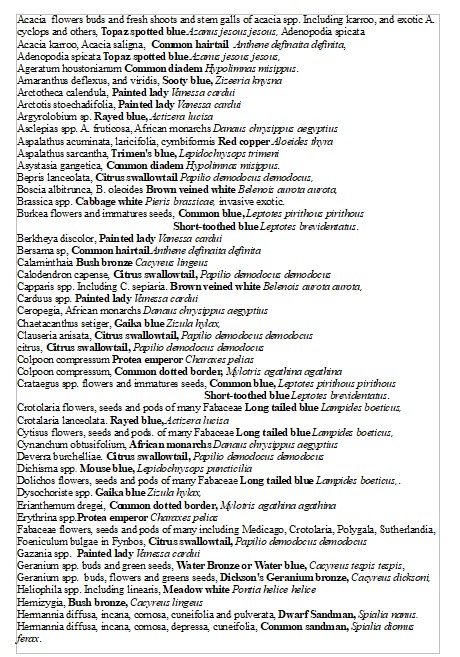
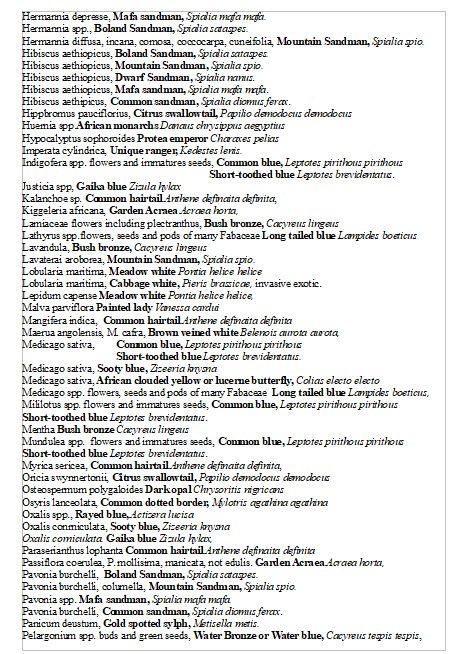
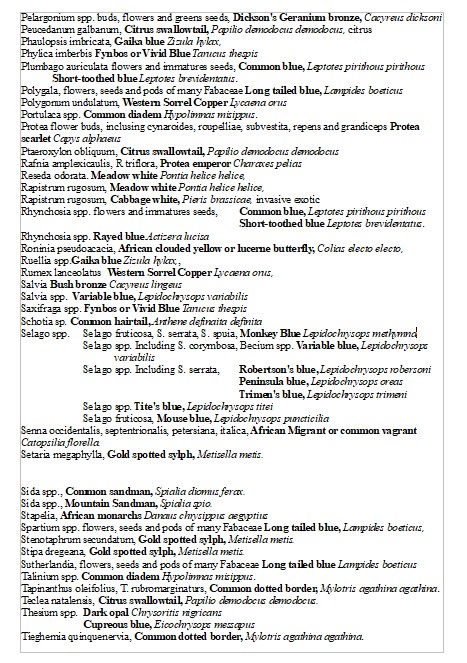
LARVAL FOOD OF BUTTERFLIES OF WHICH THE DISTRIBUTION INCLUDES CAPE TOWN AND PENINSULA
THREE WAYS TO REWARD MY WORK THAT WILL COST YOU NOTHING AT ALL. Dear Reader, in this age of AI created content, please support my human-made content. It requires a lot of research and garden experimentation, aka blood sweat and tears, the last ten years. You pay me back by signing up for the free newsletter (once a month, no spamming) at the top of the lefthand column or below. Please use the response form at the bottom of the page to respond directly to its content. If you find what I give you useful I would appreciate a share to the social media platform of your choice, the buttons are on the extreme right of your screen, Just click them !
Restore Nature Newsletter
I've been writing for four years now and I would love to hear from you
Please let me know if you have any questions, comments or stories to share on gardening, permaculture, regenerative agriculture, food forests, natural gardening, do nothing gardening, observations about pests and diseases, foraging, dealing with and using weeds constructively, composting and going offgrid.
Your second block of text...

SEARCH
Order the Kindle E-book for the SPECIAL PRICE of only
Prices valid till 30.09.2023
"How to start a profitable worm business on a shoestring budget
Order a printed copy from "Amazon" at the SPECIAL PRICE of only
or a digital version from the "Kindle" store at the SPECIAL PRICE of only
Prices valid till 30.09.2023